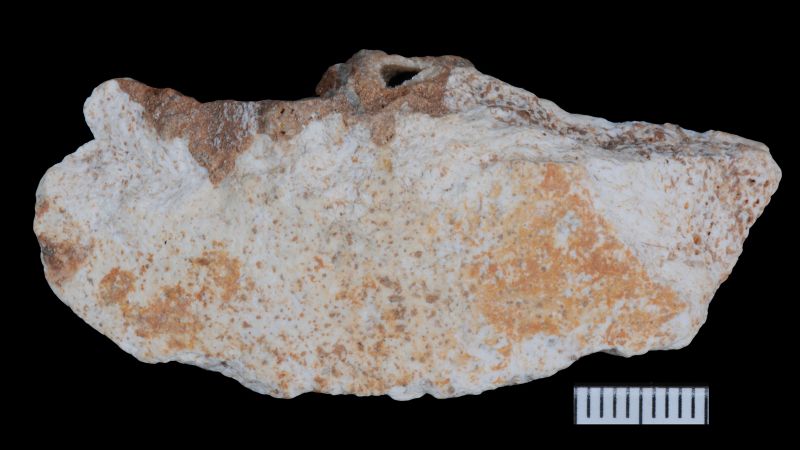
Archaeologists excavating a cave in southwestern China have unearthed fossilized remains that belonged to an enigmatic population of extinct hominids, revealing new details about their long-lost way of life. The new haul, which includes four teeth, part of an arm bone and two skull fragments, brings the total number of known fossils of these mysterious human relatives, called Denisovans, to more than 20. The discovery also establishes Bianfu Cave in the mountains of Yunnan province as an exciting new site in the study of human origins. In addition to the seven Denisova fossils, researchers discovered bone and stone tools, as well as fossilized pollen and animal remains. The findings paint a picture of how the Denisovans who called the cave home made life in the region’s coniferous forests between 167,000 and 134,000 years ago, according to two studies published in the journal Nature on Wednesday. “We first identified some isolated teeth, and then from the huge amount of animal fossils, we identified the bones, but the fragments were very difficult to find at first,” said Hao Li, a research professor at the Tibetan Plateau Research Institute of the Chinese Academy of Sciences in Beijing and co-author of both papers. “We are very fortunate because this is the first site in southern China that has a direct association between the Denisova fossils and rich cultural remains,” he added. “This is very strange.” Previously, research on the Denisovans had had to rely heavily on isolated discoveries with uncertain and complicated backgrounds, such as a skull recovered from a well in northeast China and a jaw dredged from the seafloor by a fishing boat. A team of scientists first identified the Denisovans in 2010 from ancient DNA extracted from a small finger bone found in the Denisova Cave in Siberia, hence the group’s nickname. The breakthrough was the first time a previously unknown hominid species was identified based on DNA alone. However, it is known that Neanderthals, Denisovans and our own species, Homo sapiens, took refuge and mixed in Denisova Cave. Discovering concrete details about the Denisovan lifestyle from this site alone proved challenging. That’s why Bianfu Cave, named after the bats that once lived there, excites paleoanthropologists: it appears to have been occupied only by Denisovans for a considerable period of time. Consequently, the researchers found the fossils in their original context along with tools and other remains that allow archaeologists to date them more reliably and infer unprecedented information about the group’s habits and behavior. Scientists have hypothesized that Denisovans lived throughout Asia. Today, people from Southeast Asia and Oceania carry the most Denisovan DNA, indicating that Denisovans interbred with modern humans in these areas tens of thousands of years ago. However, most Denisovan fossils have been found in northern Asia. The discovery of Bianfu Cave marks only the third place where Denisovans are definitively known to have lived and shows that this group occupied a wide range of environments: Siberian mountains, the high-altitude Tibetan plateau and subtropical latitudes. The researchers combed through 60,000 bone fragments excavated from the cave, identified about two dozen that looked very similar to hominid bones, and tested them to see if the fossils contained any useful biomolecular information. The study authors determined that no ancient DNA had been preserved in the remains. But the team recovered variants of amino acids, molecules that make up proteins, that suggested three bones and two teeth were Denisovan, according to the new studies. The research team classified the other two teeth, which were too fragile to be sampled in the laboratory, as Denisovan based on their morphology and by comparing them with other known teeth of the species. “DNA is more vulnerable to degradation than proteins, and it is difficult to preserve it in these fossils since they were more than 100,000 years old. The relatively warmer climate in Yunnan also hampered the preservation of DNA,” said study co-author Qiaomei Fu, a professor at the Institute of Vertebrate Paleontology and Paleoanthropology, part of the Chinese Academy of Sciences in Beijing. Fu was also part of the team that first identified the Denisovans in 2010. The skull hidden in a well in northeast China has put a face to the Denisovans. height=”1334″ width=”2000″ loading=’lazy’/> The team dug three trenches at the cave site to a depth of 6.6 meters (22 feet), but only one trench yielded human fossils, in two layers of sediment dating from 167,000 to 134,000 years ago. was occupied between 190,000 and 70,000 years ago, one of the new studies focused on markings on animal bones and stone tools unearthed in the cave. The authors found that Denisovans living in Bianfu made stone and bone tools and hunted large prey, such as water buffalo, bison-like gaurs, and red and sika deer that lived in the forest environment, according to the study. who described the artifacts as a “convenient technology.” “I wouldn’t say ‘simple’ because it’s a kind of flexible adaptation,” Li said. “When they used the stone tools, they didn’t spend much time.” Li added that it is most plausible that the only occupants of the site were Denisovans. persist In addition to expanding the species’ known range, the new fossil finds include the first known Denisova arm bone. Scientists can glean limited information from the bone fragment, but its radius was short, somewhat like that of Neanderthals, according to Ryan McRae, a paleoanthropologist at the Smithsonian National Museum of Natural History in Washington, D.C. “And the insertion of the biceps muscle is oriented in such a way that it may have been more efficient in flexing the elbow,” said McRae, who was not involved in the study. “More interesting is the site itself,” he added. “It tells us about Denisovan occupation at a site over a considerable period of time and, at the same time, fills in some geographical gaps in our understanding of the Denisovans.” Until last year, scientists knew very little about what the Denisovans looked like, as most of the fossils discovered so far were small fragments. specimen came to light in 2018 after having been hidden for decades at the bottom of a well in the northeastern Chinese city of Harbin. The research team extracted genetic material from Dragon Man and linked it to the Denisovans, finally giving the species a face and a proposed scientific name: Homo longi. Much of the group remains a mystery, with scientists only having a finger bone, a rib fragment, and a forearm bone to study. described in the new research. There is still much to discover about what the Denisovans were like, how they lived and why they disappeared. Yunnan, which means “south of the clouds”, may provide some answers to these and other questions. Several Stone Age sites have been discovered in the region in recent years, with finds such as rarely unearthed wooden tools dating back 300,000 years. hospitable climate, rich in plant and animal life. The province probably acted as a crossroads connecting North and South Asia. “We are on the margins of the Tibetan Plateau, above 2,000 meters, but not at too high an altitude,” Li said. “This is an important point for biodiversity and would have provided rich resources for ancient hominids in this region.”