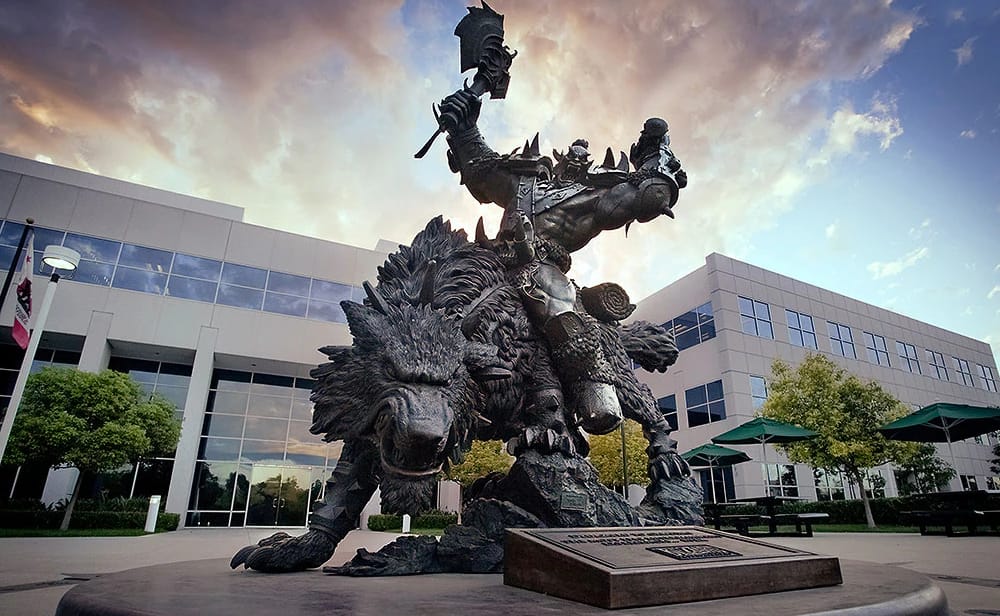
Even before Microsoft laid off 1,600 employees (with 1,600 more to come) earlier this year—prompting multiple series of demonstrations at studios across the country—Blizzard workers were marching outside the house that Warcraft built in Irvine, California. Since 2024 teams across countless projects like World of Warcraft, Overwatch, Diablo, Story & Franchise Development, and Platform & Technology had unionized one by one, with Microsoft and Blizzard voluntarily recognizing those unions per the terms of a legally binding neutrality agreement brokered by CWA, the larger union helping game workers organize. But when workers and higher-ups reached the bargaining table, they failed to see eye to eye. And that’s when higher-ups gave workers any bargaining time at all.Two years of tumult later, Blizzard unions finally have a contract, and its terms extend to all unionized units at the company (as opposed to different sets of rights and protections for different teams). It covers 1,900 workers in total and includes the above units as well as Hearthstone & Warcraft Rumble and Quality Assurance, the latter of which previously secured its own contract.“We really started mobilizing as one Blizzard unit in [the] last couple of months, and I think that really helped put the pressure on,” Paul Cox, senior game designer on World of Warcraft, told Aftermath.”I feel like the company dragged its feet and did a lot of posturing and wasting time until the very, very last moment.”Prior to spring of this year, the WoW team, which unionized in 2024, had gotten the lion’s share of bargaining time. Other units found themselves stuck in the mud. Higher-ups were effectively stalling the whole process—unfortunately nothing new for unionized workers under Microsoft’s umbrella.”For this whole year of bargaining on the Diablo side—and I imagine on the rest of the units as well—we received so few [bargaining] dates, but we kind of had the understanding that whatever WoW was able to win would at least influence and set the floor for the rest of our units,” Diablo senior environment artist Mahreen Fatima told Aftermath. “We adopted this messaging about how WoW’s wins are our wins, so we should be out there mobilizing with them. But truly, I feel like the company dragged its feet and did a lot of posturing and wasting time until the very, very last moment this last month to finally be able to say, ‘OK, yes, we are willing to extend this contract to everyone.’ We really did not have any indication that we could get this done until last month.” The WoW unit had to fight tooth and nail for every last guarantee.”WoW, especially, had to bargain every little thing—all the stuff the company gives us normally,” Blizzard senior editor Alison Veneto told Aftermath. “Even if the company’s provided it for 20 years, they don’t want to put it in writing because then they can’t take it away again. So we had to do everything from wages down to what happens if there’s inclement weather, and everything in between. We spent two days talking about [keys and money Blizzard gives us to use in Blizzard games].””I’ve worked here for 19 years,” said Cox, “and they have always given us keys for things that Blizzard makes. They fought us on that. We have always been given winter break, and they fought us on that as well.”CWAWhat changed in the past month? You might point to layoffs and the furor surrounding them, but Blizzard employees to whom Aftermath spoke didn’t characterize the shot Microsoft aimed at its own foot as the silver bullet. Instead, they said, workers made it clear to the company that if they got a tidy contract, everybody would win.”It’s mutually beneficial for our union and the company,” said Fatima. “We made some statements at our separate tables on Diablo a couple months ago about ‘Do you really want to be renegotiating every letter of every proposal after it comes out of WoW and then have Diablo and then Overwatch rehash and spend 80-plus days [on it]? Is this really a good use of our time?'””I don’t think [the reaction to layoffs moved the needle much],” Cox added. “Alex, our bargaining chair, talking with Nick, [the company’s] bargaining chair, was like ‘Blizzard, do you want to be bargaining eight tables basically permanently?’ [Blizzard] realized ‘Oh, this is mutually beneficial. We can get out of an insane level of bargaining on our side.'” But that’s not to say that unionized workers had zero aces up their sleeves.”Mobilizing [played a big role],” said Veneto. “I mean, a few hundred people were outside the orc statue [on Blizzard campus] making noise on a regular basis. That was making a big splash, and I’ll go ahead and say it: BlizzCon is next week. Going into BlizzCon without a contract with the level of mobilization that had been ramping up from Blizzard employees could have been uncomfortable [for the company].””A few hundred people were outside the orc statue [on Blizzard campus] making noise on a regular basis. That was making a big splash, and I’ll go ahead and say it: BlizzCon is next week.”Still, negotiations came down to the wire, and workers like Fatima—who’s remote and traveled to Irvine for a week in August assuming she’d see the WoW team finally bring home a hard-won contract—repeatedly had their expectations subverted. By the time the dust had settled, workers spent something like 70 hours in a conference room over the course of five days, and they got a contract for everyone, not just the WoW team.But while layoffs may not have convinced Blizzard to finally thaw its icy bargaining table disposition, they were certainly top of mind for workers. Microsoft is still planning to kick another 1,600 employees to the curb sometime in the next year, and though Blizzard mostly dodged the boss’ boot last time around, it’s impossible to say what the future holds. The contract should at least help with that.“One of the things that we got in there was really strong layoff protections,” said Cox. That includes a bare minimum of four weeks of severance plus an additional week for every six months an employee has worked at Blizzard, up to a maximum of 39 weeks. The unions also won something those at other studios, like Zenimax, bargained for following previous layoffs: recall rights. Blizzard’s, however, are more expansive.“It’s not just recall rights into your unit; it’s recall rights into any job that you would be qualified for,” said Cox. “So if WoW has a bunch of layoffs, but Diablo doesn’t, and Diablo is looking to expand, the folks who are laid off from WoW can get recalled into Diablo if they’re qualified, which has definitely never happened in our industry before, and is very rare to see just in general. So we are really excited about that.”All unionized units under Blizzard qualify for recall rights, which span 14 months.“14 months from the layoff, you can be recalled into an open position that you’re qualified for,” said Veneto. “This is kind of common in other parts of the unionized world, but we believe this is a first for the tech industry to have recall rights like these.””We have finally entered the industrialized world where most countries have these kinds of protections—where an employee cannot just be laid off because your vibe wasn’t great or whatever.”Another big win as far as video game workers are concerned: just cause protections.”Now that we have just cause, we have finally entered the industrialized world where most countries have these kinds of protections—where an employee cannot just be laid off because your vibe wasn’t great or whatever,” said Fatima. “It’s, like, a foreign concept to us here in America. Right now, someone could lay you off because it’s a Tuesday or they don’t like your energy, and that’s not normal. Now we have just cause to protect us from that.”Workers also contractually locked in their current hybrid work schedule, meaning that Blizzard can’t suddenly change it, as has been a labor-unfriendly trend in the games industry over the past couple years. Fully remote workers scored a big win as well.“I’m remote, and we grandfathered everyone who is remote to stay remote, so we can’t be magically called to an office that we’ve never worked at before,” said Fatima.CWABut while employment is preferable to the alternative, it’s not like everyone at Blizzard—even with all the company’s prestige—commands a sizable salary. Before the contract was ratified, some employees were making under $50,000 per year. Now, at least, there are a series of salary floors in place that range between $51,840 and $70,400 depending on which city an employee is based out of. “The highest raise that someone is seeing from this contract is a 34% increase,” said Fatima. “But it’s because they were so severely underpaid.”More broadly, pay is one area in which unionized workers feel like they compromised. “We’d hoped that we would get more pay,” said Cox. “We did get an increase in wages; it just wasn’t as big as we would have hoped. I thought that we would get more pay and less of the many other things that we won. I’m surprised we got locking in remote and locking in hybrid, given that literally every other Activision studio is back in at least four or five days. I’m surprised we got the really good layoff protections, given how layoff happy this industry is. … Of our top-five issues, we got four of them, and four out of five is pretty good.”“The highest raise that someone is seeing from this contract is a 34% increase. But it’s because they were so severely underpaid.”The contract isn’t perfect, but Veneto believes that it makes for a solid foundation atop which others can build.”I do think one place we can have a really big impact is on the rest of the video game industry,” she said, “because I think this is a really good contract, and it sets a great standard for other unionized workers who are coming after this.”Speaking of foundations, like their not-so-next-door neighbors at Zenimax, Blizzard workers also secured AI protections.”The company has to talk with us before implementing AI tech that affects our working conditions, and we get to negotiate over the impact of that,” said Cox. “We’ll also be regularly discussing AI as part of our labor management committee, which is the sort of meeting between the union and the company on a frequent basis where we can bring up everything from AI to ‘Hey, people are complaining that the toilet doors have too large of a gap in them.'”“AI is difficult because over the four-to-five-year life of the contract, it’s kind of hard to know what’s going to happen,” added Veneto. “So I think getting that impact bargaining, where we can bargain the impacts that the AI use has on the workers, is a good place to be. It’s hard to get too specific. Who knows what’s going to be happening five years from now?”As for what’s happening now, Blizzard, like many other video game companies and Microsoft subsidies, is experimenting with AI—though workers stopped short of answering a question about which teams are most regularly deploying the brain-deflating tech. “Some teams have been impacted by AI and the push to use more AI,” said Veneto. “I think we’re all still figuring out where it works in our workflow and where we think it benefits us.””Some teams and projects are experimenting and leaning into AI more than others,” said Fatima. “I don’t know if it’s safe to say it’s a common occurrence because it really is dependent on the leadership of each project and how the leads want to take the direction of that project and their team.””Some teams and projects are experimenting and leaning into AI more than others.” But that, Fatima continued, is why AI protections matter.“The silver lining here is that it highlights to everyone just how urgent it is to get AI language and protections in the first place, because we can see firsthand what the results of that are,” she said. “Previously, whenever employees brought up concerns about the way AI is being used or had red flags about how it’s impacting their workflow or their skills or the game or the players or what have you, they had a sense that leadership wasn’t always listening to them and working through their legitimate concerns. The AI language we got gives us a seat at the table to discuss and evaluate and bargain and actually have our voices heard.”AI is far from the only noxious gas burbling up from the belly of the beast that is Microsoft; previously, a contingent of Microsoft workers—including unionized developers at Dishonored and Deathloop studio Arkane—publicly decried the company’s complicity in Israel’s genocide of Palestinians. Could Blizzard’s many unionized workers put their now-considerable weight behind similar causes in the future?”I think the difficulty is that we have 1,900 people, so it would have to be on things that the majority of our membership supports,” said Veneto. “But I will say that I was really surprised when we did our bargaining survey for our team how much diversity and social justice issues came up. I think that is of interest to a lot of people, but we’ve been so focused on getting the contract through at this point.””All of us are still fairly new to unions and having an understanding of how much we can achieve,” said Fatima. “We still have the opportunity to think even bigger and think outside of ourselves—of not just change for our industry, but for our society, our country. We can go further. It just depends on the strength of our union. So I think there will come a day when we can think even bigger picture than this.””The strength of the contract is dependent on how willing we are to defend it.”In the shorter term, Blizzard’s unionized workers are certain that they’ll be forced to hold Blizzard and Microsoft to account in other ways.”We already know from our union siblings at [Blizzard] Albany/Austin [and] Zenimax—the folks who have already gotten a contract—that the company will violate the contract and will not follow it,” said Fatima. “So really, the strength of the contract is dependent on how willing we are to defend it and defend the language. That’s one of the things we’ll be working on for the next several years.””Now that the contract is ratified, this is not the end,” said Veneto. “We don’t just take a nap now, because we have to enforce the contract. Somebody said this is like a live service game. It’s kind of true.”RecommendedGame Workers Rally Against Microsoft Layoffs: ‘Corporate Greed Is Destroying Our Games And Our Livelihoods’Former and current workers and supporters rallied outside ZeniMax offices across the US and Canada to protest Microsoft’s latest cuts