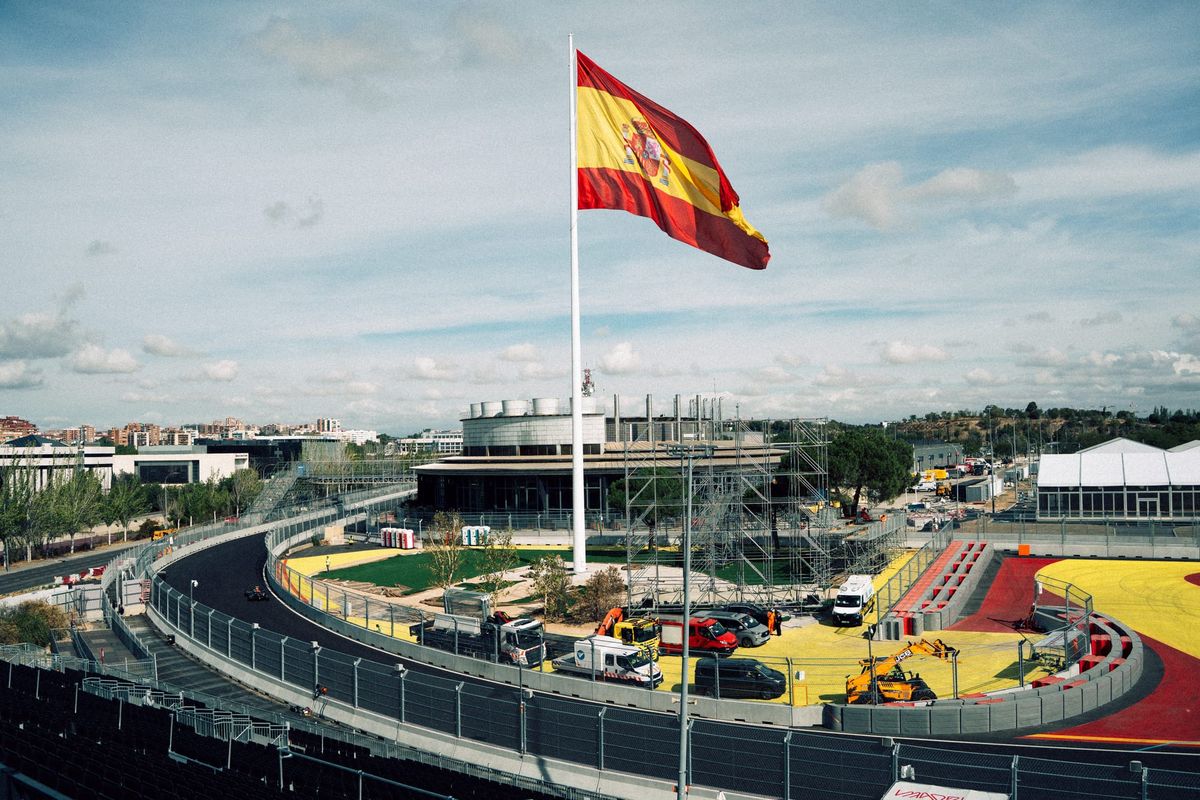
The new venue for Formula 1’s Spanish Grand Prix has been described as a “car killer”. The first race at the new Madring circuit will take place this weekend, but it is only now that F1 drivers are starting to realize what a challenge the circuit will be. Those who have already driven it have described it as a mix of Monaco, Macau and Jeddah. It’s an old school circuit with proper character and corners that have the potential to become instant classics. But there are fears about what kind of racing it will produce and how brutal it could be for the cars and drivers. Having explored the circuit during its construction in June, we have since investigated further exactly what kind of challenge the track will present and what we can expect this weekend. The biggest indicator of that was the two-day Formula 3 test held there a couple of weeks ago. “In the Formula 3 test there were 19 red flags and three broken chassis, broken suspensions… Okay, they are Formula 3 drivers, but it is a track that kills cars,” Williams F1 team director James Vowles told a Spanish media outlet. Sport.The Race understands that some F3 teams were not very impressed by having to test there, because the list of damaged parts was so long. But that F3 test was invaluable as a pilot episode for the F1 event in Madrid, requested by the circuit organizer to try to avoid the kind of problems that plagued the Las Vegas debut when faulty drain covers disrupted practice, wrecked Carlos Sainz’s Ferrari and infuriated team principal Fred Vasseur. The chaotic F3 test has also acted as a warning sign for F1 teams and drivers about how challenging it will be. Ferrari held an F1 filming day there in July, but that was on a much tougher version of the circuit, so the F3 race was the first proper test for the venue. What worries F1 teams and drivers is that the 19 red flags in F3 were scattered throughout the circuit (see below). It means there isn’t a single danger zone to navigate, as there are plenty of places where you can come unstuck and end up with a hefty repair bill. With many teams working their remaining development budget within the 2026 cost cap, the last thing they’ll want is a wrecked car. The danger zones We spoke to several F3 drivers and teams to find out why Madring is so challenging in so many different ways and why there were so many red flags. When asked why it’s so challenging, Audi-backed F3 championship leader Freddie Slater told The Race: “Because the corners that are there, they’re very tight and unforgiving, and then the walls come at you on the exit of the corners. They don’t pull away from you like most tracks. “You’re always coming out of the corner and trying to get away from it rather than maximizing, so it’s a very tricky track to keep up with the pace of things. “You have to push, otherwise you’re slow. So I think that’s why it creates so many crashes, because if you’re not pushing yourself you’re just not at the limit. “But honestly, in my opinion, it’s probably one of the best tracks on the calendar, just because it has that old school feel. Kind of like some of the old school tracks from the UK, Macau, places like that. So I’m very excited to have the [F3 championship] “The Madring lap starts with a low-speed chicane similar to the one at Jeddah, followed by a full-speed explosion into Turns 3 and 4, which builds up into the first real danger zone: the second chicane. It’s a high-speed chicane where the wall is certainly coming towards you on the exit, and was the site of many crumpled F3 cars in the test. “That’s where there’s so much lap time because there’s an uphill section. After that, there’s a lot of lap time to gain uphill,” Slater said. “That’s why I see a lot of people taking risks obviously to get the maximum lap time, but it’s also probably where the most crashes occur. “Also, the curbs aren’t very forgiving, so you have to do it correctly, otherwise you’ll end up crashing.” It’s essentially an even harder version of the now-removed triple-apex Singapore Sling, where the trajectory is ‘head into the wall if you do it a little wrong’. It’s nothing like some of the turns in the virtual world that feel like you can jump over curbs effortlessly. And the chicane entrance is one of only two straight-ahead zones on the circuit, so drivers will reach around 340 km/h (211 mph). It’s certainly not the kind of place you’d want a straight mode failure like those on Max Verstappen’s Red Bull earlier this year. Negotiate that wall and you go under the underpass and start climbing uphill through another tricky session that also claimed many F3 cars as its victims. The circuit’s most notable feature is the banked La Monumental corner, but in reality the corners just before caught many F3 drivers in the test. There is a tight chicane followed by a quick right/left. rapid succession in turns 10 and 11 in which it is very easy to make mistakes. That then propels you onto La Monumental, a 24% banked corner that eclipses the challenge of Zandvoort’s banked corners. Pirelli chief engineer Simone Berra called it “the most severe corner” in the championship and when asked by The Race how it compared to Zandvoort’s banking, Berra said La Monumental is 20 to 30% higher. energy in the tires. Additionally, it has a completely blind start and is grip-limited rather than power-limited like the Zandvoort banked corner, meaning it puts a lot of stress on the tires and cars to give the drivers the grip they need. The F3 drivers tested many different lines during the test and expect the F1 drivers to do the same on Friday. “It feels like I’m in an IndyCar [on an oval]”Slater told The Race. “So yeah, it’s cool. It’s probably almost flat in a Formula 3 car. I think it’s going to be a bit more difficult in Formula 2 and maybe even Formula 1. “But it’s quite difficult to get the line right because obviously where the crest is, the bottom can be quite bad. It looks like an easy corner when you look at it, but actually, to drive it, it’s quite a difficult corner to get into the rhythm.” The Monumental only marks the halfway point of the lap and there are many more challenging corners after that, such as the tight turn 17. on the right. There is very little breathing room around the turn and being conservative doesn’t work either. The winner of the F3 sprint race at Monza, Taito Kato, explained: “If you want to gain lap time, you have to push until you are close to the wall, so it is risky but fun to drive.” Sainz, who is an ambassador for this grand prix, explained that he was referring to his surprise in terms of F1 adding a track that has real character, unlike some of the softer tracks that have been added to the calendar in recent years. And while he acknowledges that it has been an F3 car killer, it remains to be seen if it will be. Sainz also said “we all expect safety cars, red flags and yellow flags in qualifying.” Audi F1 driver Gabriel Bortoleto said: “It looks like a very interesting track, dangerous, but at the same time very challenging and it’s nice to race on a new track like that.” When asked if it was dangerous, Sergio Pérez noted: “To be honest, I don’t think it’s more dangerous than Jeddah.” low speed corners. Arvid Lindblad called it “a real drivers’ track” and there are predictions of an edge-of-the-seat qualifying with razor-thin margins and the potential for a Monza-type Surprise. But it is those same reasons that raise fears about Sunday’s race day fears. So expect an exciting qualifying in Madrid, but there are concerns that the Grand Prix could be something of a procession. There are plenty of obvious overtaking opportunities. There are plenty of reloading opportunities on the lap, so one would expect a more traditional F1 race like the one in Hungary than the overtaking bonanzas of Monza, Silverstone or Spa. Alex Albon even joked: “I don’t think there will be any overtaking. I hope you find the solution.” [Monza] and ignore next weekend.” Of course, chaos could liven up the race if there are safety car or red flag interventions. But there is also the element of F2 and F3 racing there this weekend, with five races between them before the F1 grand prix. Baku, the predecessor of F2 GP2 had probably its craziest round before the F1 grand prix, with 17 retirements in the two races due to accidents. The F1 drivers at the time were consequently cautious in their race and it turned out to be a boring debut, with chaos predicted in the Baku F1 in the following years. Yes, I remember. I was there in 2016 in Baku and I think that we F1 drivers tend to be a little more disciplined in these things,” said Sainz. “Obviously we have greater responsibilities due to the fact that we represent a thousand people in the factory that builds those cars and we have to be a little more careful with the material. We know that sometimes we also have parts limitations and we also have more experience, so we also drive faster cars, which are usually easier to crash. “But yes, we tend to have a little more discipline with that. “Also from a safety and circuit recommendation perspective, I think even watching a live FP1, almost sometimes we could send a text message to the race director and tell him that this curb doesn’t make sense, that it’s going to lead to an accident or a bad moment. “We can help the race director and the FIA learn over the weekend with us while looking at the same kind of patterns. “It feels almost inevitable that someone will get caught up this weekend. And there aren’t many places around here where you can make a mistake and come out on top Whichever route he takes, Sainz has urged his fellow drivers not to rush to judge the merits of the circuit, asking for a “good report” after the race on what can be improved in the future. Sainz said F1 “needs to see if it is [producing] “It’s too much” chaos and he expects there to be things that are “going very well and other things that are not going so well.” He noted that Miami had what he called a “kind of disastrous” debut in 2022 before becoming a “great grand prix,” so he wants the same patience for Madrid. But with so many cities competing for big prizes now, Madrid will want to make an immediate impact to justify its place on the calendar, even if it has a 10-year calendar. contract.Its car-destroying traits and old-school features should make for an exciting qualifying session. The main question is whether the racing spectacle will be up to par on Sunday.