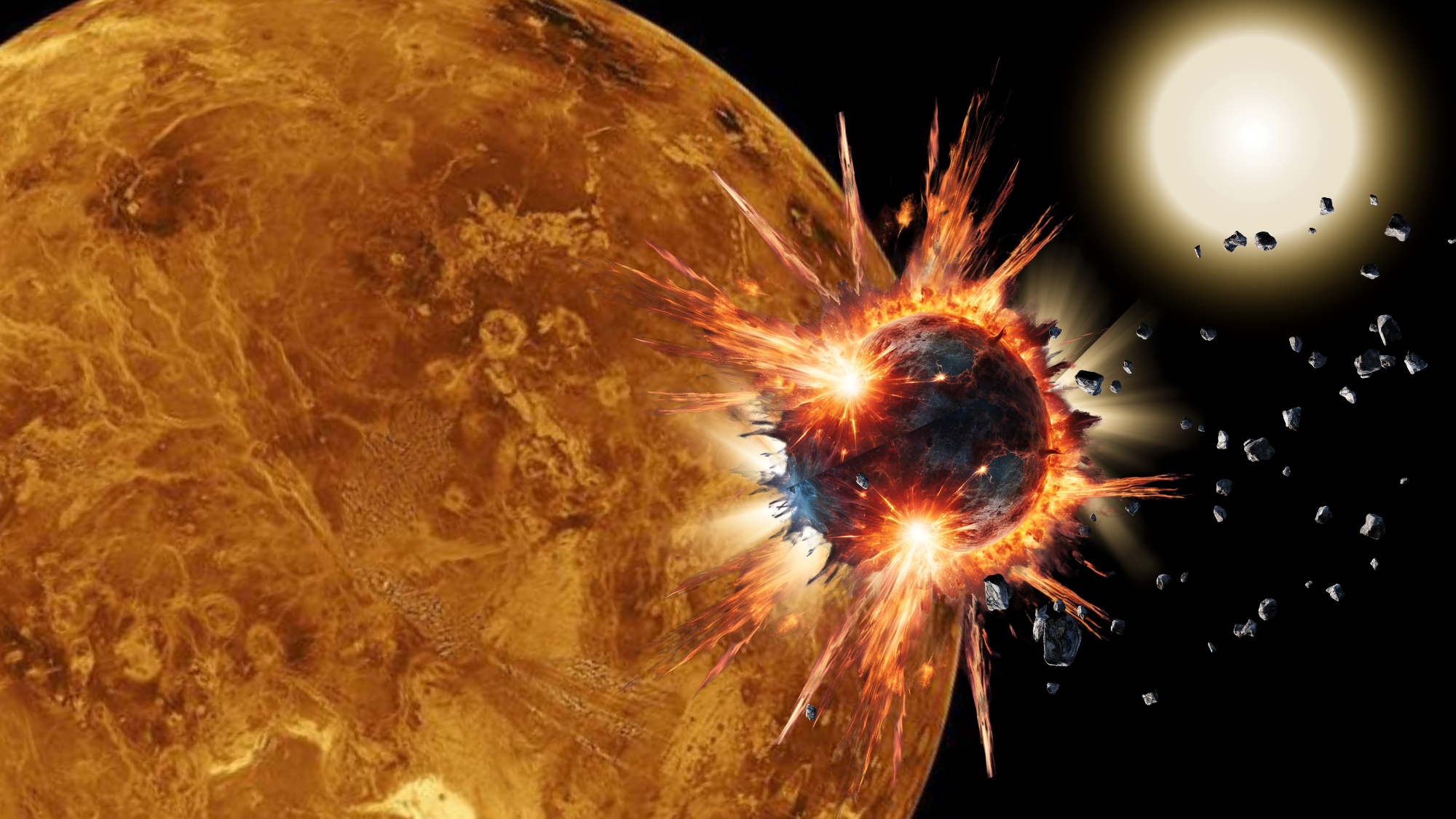
Scientists may finally know why Earth’s twin Venus lacks a moon, discovering that the solar system’s hottest planet may have consumed its own natural satellite. Venus is often called Earth’s twin due to its size, mass, rock composition, and distance from the sun, but there are some obvious differences between the two planets. Aside from Venus’ scorching temperature, which could melt lead, incredible surface pressure, violent high-speed winds, and clouds of sulfuric acid, one of the key differences between Earth and Venus can be seen from afar. While our planet has a constant companion in the form of a moon, Venus lacks a moon of its own. In fact, the only planets in the solar system that lack moons are Venus, the second planet from the sun, and Mercury, the closest planet to the sun. One question scientists have puzzled over for years is whether Venus always lacked a moon, or whether the hottest planet in the solar system once had a natural satellite and somehow lost it. Now, a team of researchers may have arrived at an answer, determining the fate that would have befallen a hypothetical moon orbiting Venus. “I have always had a fascination with the formation and evolution of the moon in the solar system, and particularly with Venus, as my research focuses on its evolution and potential for past habitability,” team leader Stephen R. Kane of the University of California, Riverside, told Space.com. “Venus is Earth’s twin, and both are almost identical in size, mass, and composition. However, Earth has a large moon, and Venus has no moon, not even a small captured satellite.” Venus certainly experienced major impacts, as did Earth, and that’s why it has had as much, if not more, opportunity to form a moon similar to the one we see in our own skies.” Kane and his colleagues built a simulation to test their ideas about what might have become of Venus’ moon. “I went back to fundamental physics and created the simulation from scratch, which I validated by making sure it could reproduce the evolution of the Earth-Moon system,” Kane said. “The moment I realized that our model provided a The full explanation of Venus having no moon was exciting!” Did Venus consume its own moon? The team modeled a gravitational tug-of-war between Venus, a hypothetical moon, and the Sun, tracking this for billions of years. “This is the same physics that governs our own moon, which is slowly moving away from Earth. “We ran the calculations across a wide range of possibilities about how fast Venus was spinning and how massive its moon might have been, using two independent mathematical descriptions of how tides work,” Kane explained. The researcher said this was done so that the conclusions reached did not depend on a set of assumptions. They found that in most cases a Venusian moon would not move safely outward like ours does. Kane and his colleagues found that possessing an intimidating size would also not guarantee the survival of a Venusian moon. “An interesting aspect is that a heavier moon is destroyed faster, since a massive moon would drain Venus’ spin so efficiently that it accelerates its destruction,” Kane added. Venus, seen from Earth, may look peaceful, but up close, it’s a hellish world that may have destroyed its own moon (Image credit: Starry Night). Did it survive? “Survival came down to two main things: Venus had to be spinning rapidly when the moon formed, with a day less than about 12 hours long, and the moon couldn’t be too massive, up to about the mass of our own moon,” team leader Stephen R. Kane of the University of California, Riverside, told Space.com. “In that narrow window, the moon migrates outward and stabilizes, much like Earth did. Outside that range, the moon is unfortunately doomed to be consumed by Venus. “A surviving moon would therefore have had to be modest in size and orbit around a rapidly rotating early Venus, conditions that don’t match what we think early Venus actually was. “We may never know conclusively whether Venus actually destroyed its own moon, as Kane believes that collecting direct evidence from astronomical observations will be very difficult. “Finding evidence from direct observation is quite difficult. A moon lost billions of years ago would leave little or nothing. direct trace that we can point a telescope at today, so we can’t observe the event itself,” Kane said. “However, there are indirect pathways. For example, if a moon was destroyed and its debris rained down on Venus, it could have left a chemical fingerprint on the planet’s surface or atmosphere, and upcoming missions to Venus, including NASA’s DAVINCI (Deep Atmosphere Venus Investigation of Noble Gass, Chemistry, and Imaging) probe, will measure atmospheric composition in detail. “If missions like DAVINCI could help us develop a better understanding of the interior of Venus, then this would also improve models like the one used in this research. This is “There is broader evidence beyond our solar system because our results predict that Venus-like planets that orbit slowly around other stars should generally not have large moons, so as astronomers begin to look for moons around exoplanets, that is a prediction that may eventually be verified with real data,” Kane said. Artist’s rendering of the DAVINCI probe approaching. (Image credit: NASA Goddard Space Flight Center) Kane and his colleagues have no intention of resting on their laurels while delivering more data from Venus or even Venus-like exoplanets. “There are numerous implications of our work that I would like to explore further. “These include the compositional and atmospheric effects of a Venus moon consumption event that may now be testable,” Kane concluded. “I would also like to explore similar effects for Mercury and Mars, and conduct further studies on exoplanet cases where such lunar collision scenarios may have occurred.” The team’s research is available as a pre-peer-reviewed paper on the arXiv repository site.