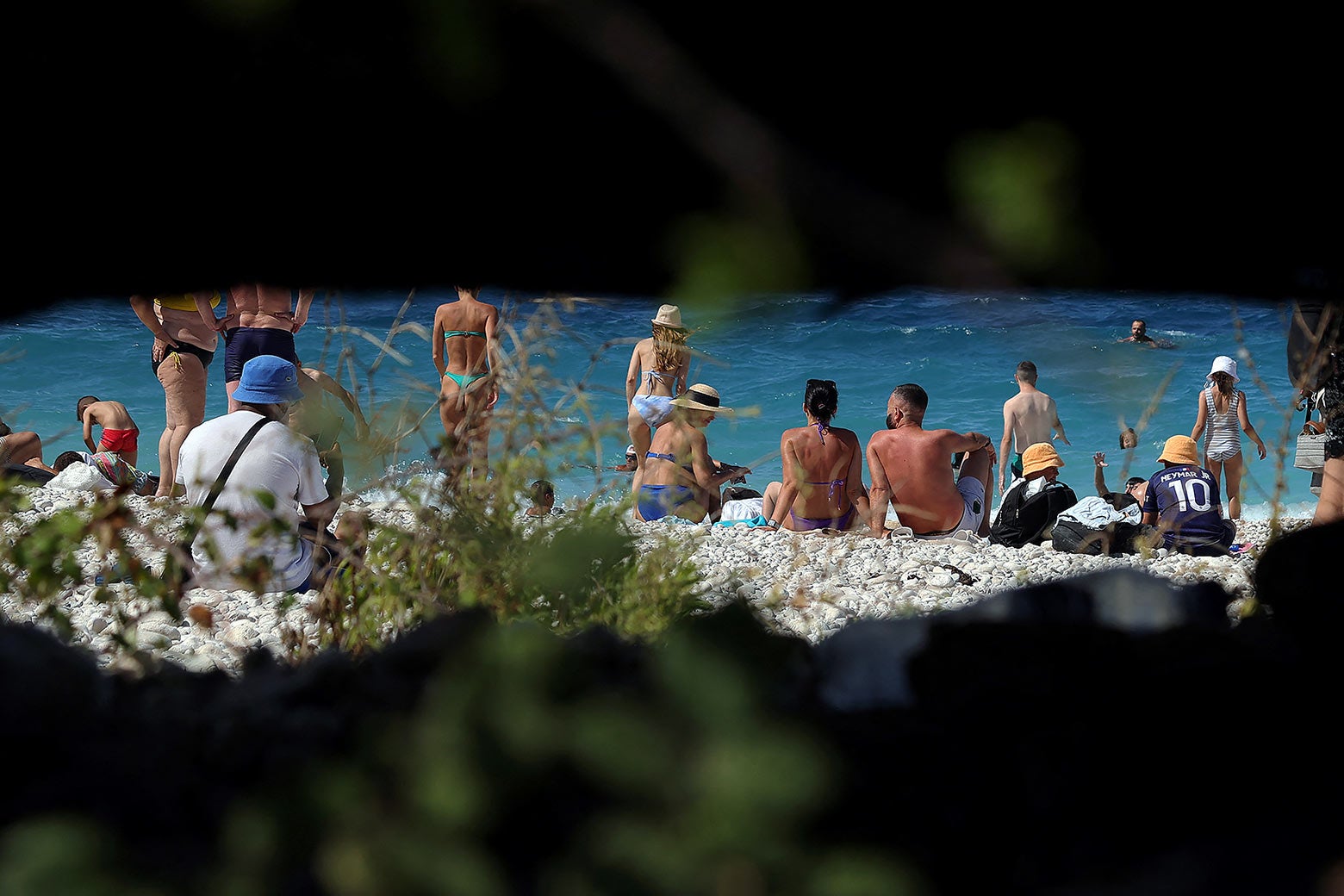
It is difficult to imagine what it is like to have nearly unlimited money. What it might be like to arrive at a Mediterranean island on a yacht and to think that the next logical step is that this island should belong to you. So you can develop it into your next real estate project, of course.
But that is the life that Ivanka Trump leads. In May, she explained such an experience on a podcast that interviews the world’s “greatest living founders”: “We were on a friend’s boat, and we stopped for a swim. Effectively, that’s how we found it. We swam to the island, we went on a hike barefoot all the way up to the top, and we were just captivated. And it stayed with us ever since, and over the course of many years, we developed the opportunity to help realize its potential.”
The “potential” of this Albanian island, called Sazan, is to become a luxury villa resort, and Trump has embarked upon this real estate project with her husband, Jared Kushner. The endeavor, worth $1.4 billion, would render many acres of Albania’s coastline unrecognizable. Because in addition to what the couple wants to build on Sazan, they are proposing to build 10,000 luxury villas on the Zvernec peninsula, which lies opposite the island. Never mind that the peninsula is currently an ecologically protected area known as the Vjosa Narta, including a river delta and lagoon that is home to hundreds of species of birds, including flamingos. They are doing it anyway, with the blessing of a government whose motivations have, shall we say, come under question.
That’s the one bit of trouble with Ivanka Trump’s little project: The people of Albania are very, very angry about it. The development has provoked fury all summer and sparked the biggest outbreak of civil unrest since communism collapsed in the country 35 years ago, in what has now been dubbed, relevantly, the Flamingo Revolution. Even the European Union has gotten involved, and not on the side of the trailblazing couple. The world has never seen a movement quite like this.
The uprising is a sight to behold, and this summer I went to Albania and beheld it. What I found is that this is not just a protest of one project in one area by one couple of American elites. Albania is a country on the cusp of becoming a tourist mecca, the next hot spot for international beachgoers to descend upon in their quest to soak up the sun and dip in the turquoise Mediterranean Sea. But the people who already live there have been scarred by decades of communism and now decades of the dodgy capitalism that replaced it. A dynastic couple calling in their orders for the country’s future from Florida is just the beginning. In Albania, I found a story with roots that go much deeper than anything that has happened this summer.
Adnan Beci/AFP via Getty Images
A routine was established over this summer for many in Tirana, Albania’s capital. Every single night at 7 p.m., once work is over and the peak of the day’s fierce heat is done, city residents turn out on the streets to protest. As I left my hotel, the television in the lobby was playing rolling news coverage of the protests. I told the receptionist at the front desk where I was going, and she said she felt guilty that she couldn’t be there herself, because of her evening shift. “But in my heart, I am there,” she said, pointing to the screen.
I met up with Olsi Nika, the founder of the environmental organization EcoAlbania, at a café on Tirana’s central Skanderbeg Square, where he was treating his 6-year-old son to a fior di latte ice cream ahead of that evening’s protests. EcoAlbania and other environmental groups have been fighting this fight since 2021, when rumblings first emerged about the sale of Sazan island and the Vjosa Narta area. What tipped this into a national movement, at the end of May this year, was a video clip taken just outside Zvernec village. Locals came out to the edge of the construction site, a fenced-off area they’d been given no warning about, and made their unhappiness about construction on their land known. The security protecting the site dragged an older local resident to the ground. It was caught on camera and went viral around the country. After that, not just a small group of dedicated environmentalists was aware of the development. Everybody was. And they were furious about it.
Olsi and his fellow activists have reasons to be hopeful that they might actually stop all this from happening. They’ve already succeeded in convincing the government to designate the Vjosa Narta river area as a national park. That happened back in 2023, after nine years of campaigning, and halted the construction of a hydropower dam that would have damaged the ecosystem. Now, this new battle has prompted a lot of additional support, though Olsi still has the specificity of a long-committed activist. When I referred to the luxury resort as a tourism development, he corrected me: “It’s just making money, it’s not about the development of tourism,” he said. That’s one thing my time in Albania clarified to me: Albanians aren’t necessarily anti-tourism. They’re anti–this tourism. “It would be fine if it wasn’t in protected areas, but they want to urbanize—badly, in my opinion—the last pristine river delta in the Mediterranean,” he said.
We arrived at the demonstration, which had gathered near the Pyramid of Tirana—once a museum to the Communist era’s leader, Enver Hoxha, and now a cultural and community center—at quarter past 8. On the first days of protest, there were about 100,000 people crowding this central street, which stretches from Skanderbeg Square down to the Polytechnic University of Tirana, a distance of almost a mile. This was the 49th day of consecutive protests, and there were still many thousands of people turning out each night, draped in Albanian flags. They’re in it for the long haul—there is a sense of orderliness, of anger and energy being spent judiciously to preserve stamina. A woman, an architect in her 40s holding a Styrofoam lawn-flamingo on a stick, told me she’d come every single day so far. I asked her how long she was planning to keep coming down. She blinked at the question.“Until we see the difference,” she said.
These protests have been overwhelmingly peaceful—family-oriented, even. At the edge of the crowd, a clutch of children were all drawing flamingos on a long piece of cardboard on the ground, and many people held pink flamingos on sticks. Groups of young people paraded around carrying banners with slogans such as “New Albania” and “Edi Rama resign.”
What was noticeably absent was any reference to Ivanka Trump.
Maybe that was an intentional rebuttal to the way the powers that be have attempted to dismiss the movement. Edi Rama, Albania’s prime minister who approved the project and welcomed it with open arms, has tried to pass off the objections as stemming from anti-Trump sentiment. “If it were not Jared Kushner … nobody would give a shit about flamingos, about Albania, about nothing,” he told the Financial Times in June. On the ground, though, the people protesting in Albania are against something much bigger. There are no anti-Trump signs, no anti-Trump slogans. The Trump connection may have attracted international attention, but Jared and Ivanka are almost beside the point.
In fact, more so than practically anywhere else in Europe, sentiment in Albania toward America is pretty positive. Their loyalty runs deep: Woodrow Wilson defended Albanian independence from the Ottoman Empire in 1919, and in 1999, the U.S. intervened in the ethnic cleansing of Albanians in Kosovo led by Serbian war criminal Slobodan Milosevic. Many here see America as a lighthouse of Western democratic values. “Because of America, Albania exists,” as one local put it to me. “For the last 100 years, they have been supporting us.”
I gradually began to realize that despite the flamingo as an organizing symbol, these protests aren’t even really about Sazan or the Zvernec development. That was just the last straw. At the edge of the crowd, I ran into Redi Muci, a member of the Albanian parliament for the left-wing party Lëvizja Bashkë, which translates as the “Together Movement,” and the party’s leader, Arlind Qori. “The main reason why Albanians are protesting is basically an economic model of very autocratic ruling of one man, Edi Rama, who is surrounded by a group of economic oligarchs,” Muci said. Yes, the idea that Ivanka Trump could waltz in and buy an island that is actually a nationally protected ecological treasure thanks to corruption sticks in the craw—but Albanians have been living under corruption at a much larger, societal scale for years, thanks to their own leaders.
“One of the most popular slogans in this protest has been ‘Albania is not for sale,’ ” Qori told me, “which means our resources, our nature, our environment, but also our democratic and representative institutions, they belong to the Albanian people, not to the Albanian corrupt government.”
Rama’s government is now in its fourth term. Once Tirana’s mayor, he became prime minister in 2013, after a campaign that ran on the promise of an “Albanian renaissance.” What he has delivered, many here think, is something decidedly less glorious.
In recent years, Rama has had two primary focuses: to get Albania into the European Union, and to attract investment. These are both fine—even positive—goals. Albania is one of the poorest countries in Europe. The average salary is just $1,000 per month. This is a country that needs money. But Rama has pursued profit for those willing to invest at the expense of sustainable economic development, many here told me. Endless construction projects are pitched, plumped up with promises of jobs and money for the local economy. Then they get started, and turn out to be something else entirely.
Florion Goga/Reuters
“The real estate system of Albania is broadly connected with organized crime and with money laundering,” Qori said. So projects get started, but only because the initial plans and proposals help money get flowing—and then they don’t conclude. He pointed at the high-rises around us, in which there were no lights on in the windows: “Ninety percent of these offices are uninhabited. They are just empty. There are no businesses there.” I asked him who owned the buildings. “Corrupted politicians, economic oligarchs, drug traffickers. The scum of the earth in terms of, you know, criminal and antisocial interests.” A 2024 report by the Global Initiative Against Transnational Organized Crime found that more than two-thirds of high-rise construction companies in Tirana, the sorts of companies who built the high-rises visible all around us at the protest, lacked both bank credit and verified financial capacity, which are taken as glaring warning signs that their funding comes from under-the-table illegal sources. But it’s in the interest of the government to approve these projects. More than half of Tirana’s municipal budget comes from revenue from construction permits and taxes.
The Vjosa Narta development, many believe, is just another chapter in the same story. “The way they finance it, and make it make sense financially, is if it’s villas that are super luxurious and very high-priced,” Muci said.
“It’s not even a business for me,” Ivanka claimed on that podcast about her island project—but it certainly will be for some, and likely a grubby one. The Albanian public prosecutor has preventatively frozen the bank accounts of two of the non-Trump investors financing the project, Syrian billionaire brothers Moutaz and Ramez Al-Khayyat. The reason is that in the eyes of the law, the brothers had no right to buy this land in the first place.
The story of who actually owns the land on the Zvernec peninsula, where Kushner and company are planning their villas, is a long and messy one. During communism, all land in Albania was collectivized. After communism’s fall, people all over Albania received titles to the property where they lived, once the land was not all de facto owned by the state. In Zvernec, because it was a rigidly protected area for environmental conservation by law, people did receive titles, but those titles didn’t permit them to develop their property however they wanted. Then suddenly, in 2006, people in Zvernec learned that their land was now officially registered to a Miami-based Albanian businessman (and suspected gangster) named Artur Shehu who has some very dodgy-seeming claims to ancestry in the area that would grant him landownership in the same way as the residents. Kusher and Trump seem to have bought the peninsula from Shehu, if indirectly. (In a statement to the Wall Street Journal, Shehu’s lawyer, Kujtim Cakrani, has said that Shehu “is neither a drug dealer nor a land thief, and he never dealt directly with Kushner—only acting through an intermediary.”)
The Zvernec residents have already been battling this appropriation of their land in the courts for 20 years, so in many ways, the Kushner development is just the latest twist. While they’ve won various stages of this legal fight, the court has perpetually dragged its feet on a final decision, and in Albania, when a legal decision is not formalized, the case can be nullified, and they have to start again from scratch. Which means everyone is on edge about how this will go. Plus, the once rock-solid legislation forbidding construction in vulnerable environmental areas like these was overturned by Rama in December 2024 to make the land available for development after all, just in time for the Kushner project to come along.
This helps explain how everything added up into a feeling I found to be universal among Albanians: Enough is enough. As I spoke with Muci and Qori, a chant went up calling for Edi Rama to go to prison. The crowd also called for the same treatment of Sali Berisha, which was notable because Berisha is the opposition leader. He was president between 1997 and 2005. But his premiership was marred by his own corruption scandals, and no one sees him as a solution. The people gathered here don’t just want to get rid of Rama in favor of the other guy. They want a full-scale reconstruction of Albanian democracy.
So far, Rama seems unmoved by protests against his government. He says the development will be going ahead. “I tell them, ‘Fuck you,’ he said in the interview with the Financial Times in June. “That simple.”
Malton Dibra/IMAGO/Light Studio Agency via Reuters Connect
To really understand the scale of what is being proposed by Kushner, Trump, and their partners, you have to go to the site itself. The following morning, bright and early to beat the heat, Olsi drove me the two hours from Tirana to the Vjosa Narta delta, which lies just north of the coastal city of Vlore. Eighty percent of the bird species in Albania can be found here, across sand dunes, pine forest, and a lagoon that stretches over 16 square miles. As we neared the lagoon, a black-winged stilt flew alongside the car, trailing its legs behind it. We got out at the northwestern edge of the lagoon, where there are swaths of land that have been churned up by heavy machinery, stretches of gravel, and remnants of fencing. This is where construction started on May 5, and continued for three weeks until the scale of the protests brought it to a temporary halt. Hastily-put-together surveying is apparently being done now in an attempt to placate the development’s detractors. Olsi reckoned it would probably start up again in the autumn, though, regardless of those survey results. “It’s like barbarians,” Olsi said as we walked past a tree that looked like it had been hacked at by a chainsaw.
There was the chirping of cicadas and the crunch of desiccated pine needles underfoot, but the most remarkable thing about the place was the quiet. Olsi produced some binoculars and showed me egrets, plovers, ducks, cormorants, bee-eaters, a pelican. Out in the distance, four flamingos were picking their way through the lagoon. The protected area is enormous, encompassing everything we could see through our binoculars from there.
There’s a reason for that.
“Lagoons are the most delicate ecosystem on the planet,” Olsi said as a small white butterfly traced his outline, “because the water exchange is fragile, the fresh and the salt water. Already, fish are dying because of small changes that the existing construction works have made.”
We drove past an undeveloped beach—no facilities, just a handful of people taking a dip—and up to a viewpoint where there was a military outpost containing one soldier and his dog. From there, you can see the entire area of the proposed development, acres and acres of it, including the stretch of unspoiled white-sand beach between the lagoon and the sea that we’d just driven past. The thing is that the coast is gorgeous. As we wound our way down the seaside road, the waters were calm and pristine beside us. But for the signs in Albanian, we could have been on the Amalfi Coast, or the Côte d’Azur, except that it has not yet been overrun with bachelorettes and party buses. That view, unlike a similar one in Spain would be, is not yet spoiled by parasols and day-trippers’ detritus.
Albania has something here that people all over the world want. At the viewpoint, Olsi got out his phone and pulled up the resort proposals, holding the map against the landscape. If Kushner and company have their way, all of it will be villas. As we looked out over the bay, its turquoise edges giving out to darker blue, Olsi pointed at a hump of land rising out of the water. “Ivanka’s private island,” he said darkly. As Jared Kushner put it to one magazine, the Dial, that island is where “I’d want to be at with my family and with my friends.” It was as telling a comment as any he’s given about the project. This will not be a normal hotel, is what he was clarifying. It will cater to the ultrawealthy—and will almost certainly mean local Albanians have much more limited access to the area.
Ivanka or not, tourism is coming for this corner of the Mediterranean. Tired of the overcrowded beaches of Italy, Greece, and Spain, savvy developers are looking for new stretches of the coastline and have landed on Albania. The city of Vlore is a central point on the burgeoning tourist trail of what is sometimes called the Albanian Riviera. Around 77,000 people live here, but that number already triples during the summer due to incoming holidaymakers. Once a working-class port city, now Vlore has a beachfront lined with ritzy bars, restaurants catering to tourists, and blocks of hotels.
A fully-fledged tourist city, Vlore is also about to get its own dedicated airport. One is being merrily constructed in the middle of a protected area; it was supposed to be finished in 2024, but true to Albanian form, it is still only half complete. Whether the airport can in fact legally be constructed is being contested in the courts even as the runways get tarmacked.
In 2023, Albania landed the distinction of being fourth in the world for the highest increase in percentage of international tourist visits, a 56 percent jump over 2019. This is a big leap in a new direction for any country, but particularly for a country like Albania. The nation is extremely young when it comes to being capitalist and Westernized at all. Albania gained independence from the Ottoman Empire in 1912 and became a monarchy. After the second World War, Enver Hoxha ushered in a severely isolated and repressive Communist regime. Communism fell in 1991, and the country has gradually, shakily established itself as a market economy and democracy.
In her memoir Free, about growing up in communist Albania, Lea Ypi, now 46, writes that in her childhood, Coca-Cola cans, unavailable in the food-stamp shops where Albanians could get their goods, were prized as heirlooms and displayed in pride of place on a family’s mantelpiece. Wealthy tourists would have felt like visitors from another solar system. Albania was sometimes called Europe’s North Korea, so cut off was it from the rest of the continent. The transition to parliamentary democracy over the past 36 years has been far from easy. One person I met in Vlore told me he remembered aid packages being flown in from Italy full of long-expired pasta. Everyone over 35 remembers the bloody civil war of 1997—and those younger grew up in its shadow. To go from that to the proposed high-end beach clubs and already present budget-airline weekenders involves extreme whiplash.
Still, Albanians see tourism’s potential for their country. But for the country’s counterparts—Portugal, Italy, Greece, Spain—tourism is the focus of protests by locals because overtourism is driving up the cost of living and crowding them out of their homes. These more developed countries have served as a warning for Albania: What the locals here realize is that they still have time to approach their coastal fortunes differently. They seek to disabuse their leaders of the fantasy that tourism will be a magic bullet that will somehow bring sustainable economic development to the area.
To get a better idea of what the Albanian Riviera currently looks like, I took a trip down the coastline from Vlore with a man named Aulon Harizaj in his old banger of a VW Polo. Aulon, 38, was born and bred here in Vlore. He had been thinking of going abroad to study mechanical engineering, in Italy or Denmark, but then the protests began, and he decided to stay for the time being and do his part.
“You know the boiling frog experiment?” he said as he smoked a cigar out of the car’s open window. “We have been through something like that, politically.” The temperature was slowly rising for some time, and then there was that video of the local man being dragged by the police out of the construction fence in Zvernec. Suddenly, the frog jumped out of the pot.
“That was when everything exploded. On a personal level, we felt betrayed, but on a broader level, we felt treasoned,” he told me. He railed against Rama’s audacity in offering up parts of Albania for sale at business meetings with men in suits. “How can you sell a piece of the country over a coffee table?”
As we drove down to Orikum, a beach town south of Vlore, Aulon spoke at length about the other times they’ve been promised benefits from luxury tourist resorts that never materialized. “We’ve had Palase Green Coast, which turned natural landscape into villas and hotels, which produced nothing but waste and ugliness.” The resort was finished, but jobs, in particular, never really opened up for local people around that development. “It’s mostly manned by Filipino workers and, compared to Albanians, they are underpaid, and the conditions they find themselves in? Appalling, to say the least. Some of them have their passports locked into safes,” he told me.
Not only are there no jobs at the resort, it doesn’t even boost other parts of the economy. Despite fertile ground, Albanian agriculture is struggling. It needs government subsidies to get back in order. But for now, most food is imported. New resorts are not buying local produce, because the local produce doesn’t exist.
A parasailer flew by overhead. I asked Aulon how much the coastline has changed in recent years, and he shook his head and lit up his cigar again as we waited to maneuver around a coach full of tourists.
“It has been subject to increasingly aggressive change. When I was younger, it was sad for me to witness. I was consoled because Vlore was not the center, but then they started attacking here too.” We passed a beach club selling Aperol and private sunbeds. “What will it be? Nothing,” he mused. “Just cafés and bars.” He pointed out a tree trunk at the edge of a construction site. “There used to be three eucalyptus there, but the hotel owner cut them down because they were obstructing his view.”
We arrived at Orikum and sat down for a caffè freddo at a café overlooking the sea.
“We have been told that tourism is the magic wand,” Aulon said, as ABBA’s “Gimme! Gimme! Gimme!” played out of speakers over the heads of a Germany family wrapped in towels at the next table; “that it will cure us and make us rich. But it will not, if you don’t produce your own food. Tourism should not be the main column of the economy, it should complement.”
Adnan Beci/AFP via Getty Images
It has only been possible for tourists to visit the island of Sazan since 2015, and no overnight stays are permitted. The island has a long and diverse military history. Italy had control of it during World War I, and then it was passed back to Albania. The Soviets established a military base there after World War II, but were booted off in 1961 because Nikita Khrushchev, then the premier of the Soviet Union, denounced Josef Stalin, which met with the disapproval of Hoxha, the Communist who led Albania for most of the 20th century. From then on, Hoxha took complete control of the island, building a settlement, banning foreigners, and limiting access even for Albanians—other than those who had proven their loyalty to his regime. At its peak, 4,000 soldiers and their families lived on the island. Sazan appealed to the infamously paranoid Hoxha as a vantage point from which he and his associates could look out for any invaders who might come sailing over the Mediterranean to interrupt his rule. Now, there is a much depleted Albanian, and Italian, military presence on the island. According to some reports, it houses just two soldiers.
This is the supposedly pristine island that Ivanka had hiked up barefoot. Now it was my turn.
Before I got on my boat, I got to talking to Regina. She was checking people in on the pier for a separate boat tour to Sazan on a replica galleon that advertises the opportunity to “be a pirate for a day.” “Maybe this will be the last year we visit,” she said of her countrymen generally. “But we hope not.” She is “of course” against the developments. “It will not be positive for the country. They will not buy from the locals, these luxury visitors, and we are not going to profit from this tourism.” She corrected herself: “They are not tourists. They are elites.”
On my boat, a packed, three-deck pleasure cruise otherwise populated by swimsuit-clad tourists and screaming infants, the story was much the same. I spoke to one of the boat staff, Alessio, after he had finished handing round slices of watermelon to the clientele. He was 18, and spending his summer working in order to pay for his training to become a doctor. “We pray that they don’t give it away,” he said as we leaned over the boat’s side and looked out at the island over the waves.
There were other stops before we got to Sazan: a beach on the Karaburun Peninsula, a look at a beloved local cave. I ended up in the orbit of Corrie, a woman in her 50s from Manchester, England, who offered me some rum and Coke that she’d smuggled on board to avoid paying boat bar prices. She’d been traveling all over the Balkans, to untouched places that seem right on the verge of being truly developed for tourism. “It feels like you’re seeing the end of something,” she said. “Maybe they need to look at the Costa del Whatsit and see what the cost is of tourism, because you can’t undo it once it’s done.”
At the height of the day’s heat, we approached Sazan. Only pine trees and rock faces are visible as you approach it by boat. It’s big, too, nearly 10 miles long, and peaky, with some squat concrete buildings up at the crest of one of the hills, and a single telegraph pole. Other tour boats skate around the limestone coast fringed with wind-blasted greenery. There are large fragments of salt-eaten machinery littering the shore, relics of the island’s martial heyday.
There are parts of the island you’re not allowed to photograph, “secure zones” consisting of dilapidated military buildings topped with ragged, sun-bleached Albanian flags. I took a walking tour with a handful of tourists from the boat and a guide, Gleni, up to the old Communist-era village. Along the rugged path (which, incidentally, you’d be insane to walk barefoot), little mushroom-shaped domes are visible, half-buried in the shrubs and blackberry bushes. These are bunkers, of which there are 3,600 on the island. Each bunker leads into an extensive tunnel network beneath the rocks that was built to protect the island in case of attack. There’s no electricity grid, and no potable water. All that will be down to the Albanian state to provide to make the Trump-Kushner development viable.
“From here, now, we have to stay on the path,” Gleni announced to us a few minutes into our walk up the hill, “because there are mines around.” Yes, Sazan is covered in unexploded land mines, a feature that, like the waterlessness and lack of electricity, doesn’t scream “luxury tourist development.”
I asked Gleni what he thought of the planned development. He’s studying for a degree in tourism at the University of Vlore. On our way up here, we had passed graffiti flamingos on the sides of bunkers and on the path itself, but he had made no reference to them in his spiel about the island’s history. He looked grave. “I’m against it. I’ve been in protests in Tirana, because we are not against tourism or development, but we are against selling the land and taking parts of protected zones, giving it to a businessman, or whatever you would call them.”
On our way back down, an Australian tourist strayed from the path toward a tunnel entrance. Gleni whipped toward him: “Come back, come back,” he said. “You’re safe, but not that much.”
For people like Jared Kushner and Ivanka Trump to have their pied-à-terre in the Mediterranean, and more importantly make a shedload of cash out of it, who has to lose? All land that tourist development happens on belongs, in some way, to someone: the state, indigenous people, or individuals. In the last part of my time in Albania, I met some of the people who are the true owners of the plot of land that was now destined to become part of the Kushner-Trump development.
Bruna Subashi, an energetic woman in her 40s, asked to convene in a luridly pink dessert parlor on Vlore’s waterfront called Big Scoop. Bruna is an academic in the field of nursing, and her husband comes from Zvernec. She was late to meet me because she stopped to sign a petition about pollution on Vlore’s beaches. “Every day we have to sign a petition to save our country, save the nature, save the city,” she sighed as we sat down. She has taken it upon herself to protest loudly and widely against the Vjosa Narta project. “I am so tired!” she said, and laughed with the near-hysteria of someone genuinely exhausted.
Bruna’s need to protest comes partly from her connection to the place: Her mother-in-law is 88, has been in Zvernec her whole life, and has spent the past 20 years battling to prove that the land on the Zvernec peninsula belongs to her and her fellow villagers. Her people have lived on this land since the fifth century. Her home in Zvernec village seems safe, but seeing what’s happened on the peninsula, now she worries about whether that will be taken away, too. She is, according to Bruna, also not sleeping well anymore.
The next day, Bruna and her husband took me to meet her, and the other owners of the property that the state has commandeered to sell to Kushner and Trump. It happened to be the day when elderly people—and most of Zvernec’s 200-odd residents are elderly people—collected their pensions of 100 euros a month, in cash, from a municipality employee installed at a table in the café-slash-shop-slash-bar at the center of the village. “It’s only enough for their medicines,” Bruna said. Life here is largely supported by children and grandchildren who have moved abroad seeking work, often construction for the men and cleaning for the women, and can send a little money back home.
At least one person in Zvernec has a sense of humor about the proposed development. A local restaurant has been renamed “Ivanka Seafood” in recent months, although when I went in there to find out exactly why, all I found was the chef, who knew nothing about it, and a large portrait of Kate Winslet as Rose in Titanic on the wall. In general, though, the mood is dark. None of the residents wanted to give me their names, though Bruna said identifying them separately wouldn’t matter. “All the inhabitants have the same problems, the same voice, they suffer the same.” And they did want to talk. The owner of the shop, a woman nearing retirement age herself, told me about her feelings on the development: “We are afraid that one day they can take our homes, too. We want to develop our village with the help of our own kids,” she said. “They work abroad, and all the finances they gather there, they could invest here.”
Suddenly, she began to cry. “People live alone here,” she said, “Their kids are all abroad, and old people die in their home and nobody notices them. Sometimes they are dead for a week.”
This Content is Available for Slate Plus members only
Ivanka Trump—and Everyone Else—Sees One European Country as the Next Mediterranean Tourist Mecca. I Went to See Why People Are So Mad.
What Was in the Mind of the Holdout Juror in the Lindsay Clancy Trial? I Can Certainly Speculate.
Republicans’ Plan for the Midterms: Bet on Trump Caring About Someone Other Than Himself
Meeting Gloria Steinem Was the Best Celebrity Interaction I Ever Had. Now I Understand Why.
Another woman began to console her, and a third woman raised her voice in anger. “We are obligated to save our land because this is our heritage from our ancestors,” she said, gesticulating, “and we want to inherit the land for other generations. We are pro-tourism, but not tourism by thieves who grab our land without permission and without compensation and without information.”
They thanked me for being there, and said they wished more Albanian journalists would come and talk to them. The Albanian media, they said, is very cozy with Rama. “This is the last way to protect our rights,” one woman said. “The inhabitants of Zvernec have a message for Rama,” she added, standing up a little taller. “We are not guests here. We are the owners of the land.”
“But Rama knows this,” Bruna added quietly. “This is not news.”
It has now been six weeks since I left Albania. Every single day since, the protests have continued. It seems the loudest message of all that Albanians have for Rama is: We are not giving up. If Ivanka Trump and Jared Kushner want their paradise island, they’re going to have to go through an entire nation to get it.