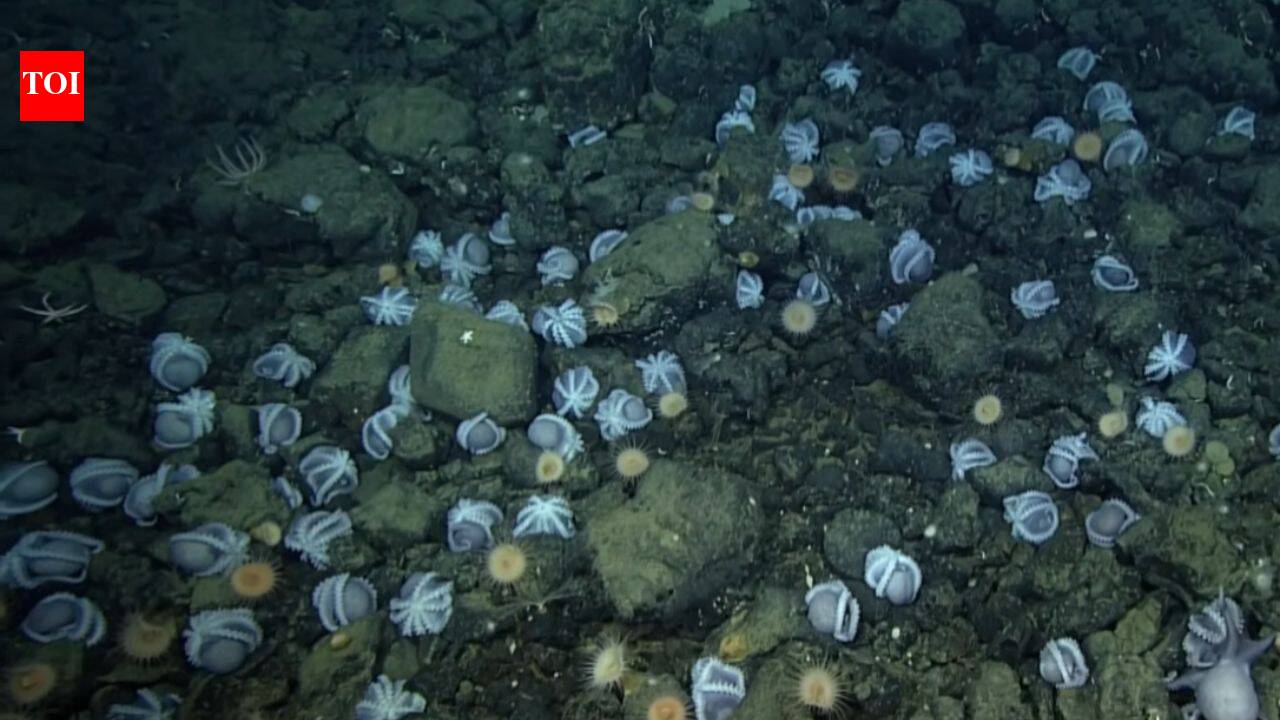
Researchers have located the planet’s largest known octopus nursery deep off the California coast, documenting 5,718 animals on 2.5 hectares and estimating around 20,000 around Davidson Seamount. Known as Octopus Garden, the nursery is located about 10,500 feet below the surface off the central coast of California. According to a statement issued by the Monterey Bay Aquarium Research Institute (MBARI) on August 23, 2023, monitoring confirmed that pearl octopuses migrate to the site to mate and nest. The Octopus Garden The species was identified as Muusoctopus robustus, known by researchers as the pearl octopus. The nursery is located on a small hill near the base of Davidson Seamount, which is an extinct volcano located 130 kilometers southwest of Monterey, California. The large concentration first attracted attention in October 2018. Researchers from the Monterey Bay National Marine Sanctuary, NOAA, Ocean Exploration Trust and their collaborators, working aboard the E/V Nautilus, observed thousands of octopuses gathered on a rocky rise near the seamount. The position of the animals helped the researchers understand exactly what was happening in that section of the ocean. Many of the octopuses were upside down, with their arms placed around their bodies, a posture associated with females protecting and incubating their eggs. The species was identified as Muusoctopus robustus, known by researchers as the pearl octopus. They have a pale violet color. According to MBARI, the animal is about the size of a grapefruit and is found in the northeastern Pacific Ocean, from Oregon to Baja California. The institute has observed the species at depths of between 2,300 and 3,600 meters. Investigation in the nursery After the initial discovery, researchers began a lengthy investigation to determine why so many animals were concentrated at that point. For three years, the institute and its partner institutions used cameras, sensors, remotely operated vehicles and other equipment to observe the behavior of the octopuses and the environmental conditions of the nursery. Doc Ricketts, an MBARI remotely operated vehicle, played a central role in the investigation. The team conducted 14 dives with the ROV during which scientists found adult males and females, developing eggs, and hatchlings. No intermediate-sized individuals or evidence of feeding were observed at the site. These observations indicated that octopuses gather there specifically to mate and nest. The size of the concentration was measured using a combination of photographs and detailed maps of the seafloor. The LASS system, installed on the Doc Ricketts ROV, made it possible to produce high-resolution images and assemble a photomosaic of the region. In this study, researchers documented 5,718 octopuses in just 2.5 hectares in the center of the Octopus Garden. The slight elevation where the nursery is located occupies approximately 333 hectares or 823 acres. Based on the studies carried out, the team estimated that the total population could easily exceed 20,000 individuals. It is the thermal conditions of the area that explain why this small area attracts so many animals. At about 3,200 meters, the normal water temperature is around 1.6°C. However, in the cracks and fissures used by the octopuses, the water heated by the hydrothermal vents reaches almost 11°C. Initial researchers observed a “sparkling” appearance to the water, caused by the mixing of hot and cold water. Later research confirmed the existence of hydrothermal vents and demonstrated that the nests are grouped precisely in the fissures bathed by the warmer water that emerges from the seabed. Why this region? The females migrate to the Octopus Garden in search of warm places to nest. Octopuses are ectothermic animals, and cold, deep waters reduce their metabolism and slow embryonic development. At the near-zero temperatures found in the abyssal environment, researchers expected that pearl octopus eggs would need five to eight years or even longer to hatch. But the temperature in these places revealed a different result. Using 4K images and features like scars to recognize the animals, scientists tracked their clutches and found that the eggs hatched in less than two years. This acceleration was attributed to the heat of the hydrothermal vents, which increases the metabolism of mothers and embryos. The longer the incubation, the longer the period during which embryos are subject to predation, injury, infection, and other sources of mortality. Females migrate to the Octopus Garden in search of warm places where they can nest. Each lays a clutch of approximately 60 elongated eggs and covers the embryos with its body as they develop. Interestingly, the nursery also serves as a food source for other species. As is often the case with cephalopods, both male and female pearl octopuses die after reproduction. Most mothers remain alive until the eggs hatch, although some exhaust their reserves before development is complete. Their corpses are consumed by various organisms in the area. Rat fish, congrilas, sea slugs, anemones and other scavengers take advantage of the remains left after reproduction. The researchers estimated that this biomass provides 72% more food to the local marine community than would be available outside the Octopus Garden. MBARI describes the Octopus Garden as the largest known concentration of octopuses on the planet to date.