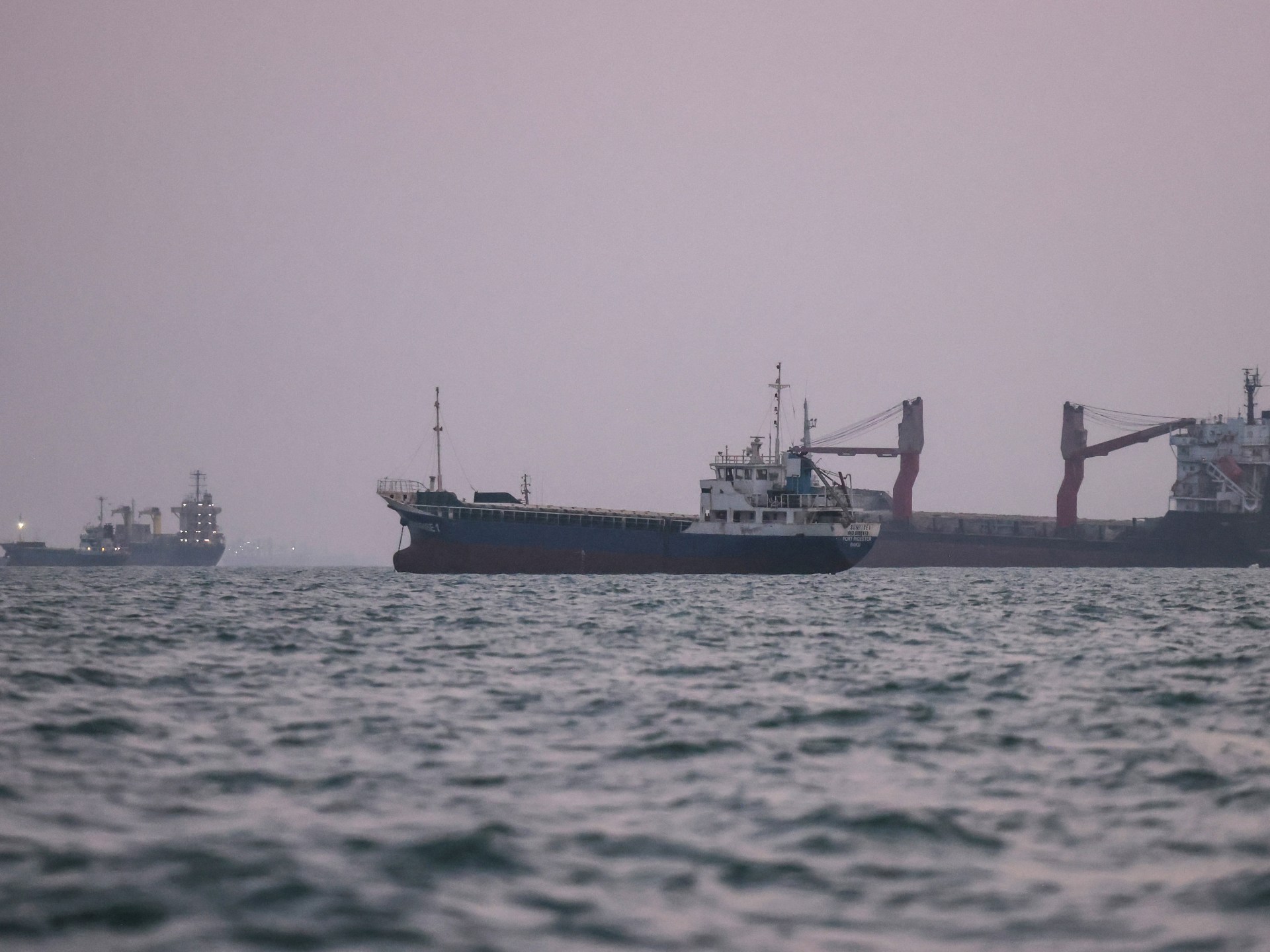
The United States and Iran have escalated their tit-for-tat attacks in the past 24 hours, with Washington attacking three Iranian oil tankers and Tehran attacking tankers and firing a ballistic missile at American warships patrolling near the Strait of Hormuz. Experts have called Iran’s attacks on the two US aircraft carriers a “calculated escalation” as months-long fighting increasingly takes place at sea, with both sides seeking to exert control over the strategic strait, a global threat. Choke point used by Tehran as leverage in the war. So what do we know about the latest tanker wars and where the conflict is headed? What do we know about the latest attacks on oil tankers? The US Central Command (CENTCOM) said its forces attacked three Iranian vessels, including an oil tanker off Kharg Island, the hub through which Iran exported 90 percent of its crude oil before the war. The attacks followed Iranian ballistic missile launches at an aircraft carrier and a US Navy destroyer, which it said successfully evaded the attacks. No US personnel were injured. “If they fire on two of our ships, we will impose an even greater economic cost: we will eliminate three of their ships,” said CENTCOM Commander Adm. Brad Cooper. Iran’s Islamic Revolutionary Guard Corps (IRGC) said it launched “several ballistic missiles” at the aircraft carrier and destroyer, accusing them of “harassing Iranian ships” and participating in a naval blockade. “The Iranians not only attacked two ordinary warships, they targeted a missile. “This is a very, very significant development, and it is not a surprise that the Americans have retaliated.” The IRGC navy warned all vessels in the Gulf or near the Strait of Hormuz not to be “fooled” by the US military and to “refrain from any suspicious movement aimed at transiting unauthorized waterways.” “Otherwise, you will be a target,” said. On Sunday, Iran claimed it had attacked an unmanned US vessel trying to enter the Strait of Hormuz, according to The Associated Press news agency. Why are they attacking the tankers? Washington claimed that the Iranian oil tankers it hit were part of a multibillion-dollar shadow network that finances the IRGC and its regional allies. The United States began blocking Iranian ports in April. Iran effectively closed the Strait of Hormuz, through which 20 percent of the world’s oil supplies flowed, in retaliation for attacks by the United States and Israel that began on February 28. Barrels of oil flowed daily before the war began. 2026. [AFP]Hassan Ghashghavi, a lawmaker and spokesman for the Iranian Parliament’s National Security Commission, said the attacks on American warships were part of “an existential war with the United States,” arguing that Washington’s naval blockade “should never have existed” in the first place. “Naturally, they have acted militarily in violation of all international laws,” he told Al Jazeera, adding that “because the United States is far from us, it does not see this war as existential.” The United States has continued to put pressure on Iran to open the key waterway, both militarily and economically. Last month, US Treasury Secretary Scott Bessent announced a series of economic measures to attack Tehran’s financial interests around the world. Bessent said the United States would attack all of Iran’s sources of income, including oil, to prevent other countries and companies from doing business with Tehran. Dozens of ships carrying millions of barrels of oil pass through it every day. Last week, Bessent claimed that about 17 million barrels of crude oil per day had recently been shipped, according to a report in the U.K.’s The Times newspaper. However, Al Jazeera was unable to independently verify the report’s claims. President Donald Trump claimed last month that the United States was in “complete control” of the strait. However, figures from marine analysis firm Kpler show that only six ships crossed the strait on Wednesday, 11 on Tuesday and five on Monday, with a 10-day average of just 13 ships per day. What’s the latest with oil prices? The attacks add to concerns about global energy supplies. Brent crude futures closed Friday at $96.28 a barrel, their highest level since July 24, down from about $70 before the war. Unsurprisingly, oil and gas prices in the United States have also skyrocketed, at a crucial time for Trump as Americans head to the polls for the midterm elections in November. Diesel hit a new record price in the United States on Friday, rising to an average of $5.85 per gallon ($1.55 per liter) for the first time in history. Polls have repeatedly suggested that a majority of Americans oppose the war, which has also sunk Trump’s popularity. A Reuters/Ipsos poll conducted in late August found that only 31 percent of Americans support the war, while 63 percent are against it. The same poll suggested Trump’s approval rating has fallen to 33 percent, down from 40 percent since the fighting began. Where is the conflict heading? Renewed exchanges of attacks between Iran and the United States mark an escalation in the war. conflict that lasts six months, according to the director of the Middle East studies program at George Washington University, Sina Azodi. Azodi told Al Jazeera that neither side will “give in” because “it won’t suit them, so the only option is to escalate.” He said that unless there is a political agreement, the war will continue. “There will be more clashes between the Iranians and the Americans. There may be miscalculations. There may be more civilian casualties,” especially on the Iranian side, Azodi said. “He [US] The Secretary of Defense can send more troops to the region, but I don’t think the Iranians are going to back down. They are going to resist that blockade and impose more costs on the United States.” He said the goal of the United States and Iran is to force the other to back down. “The winner will be the one who can accept more costs and punishments,” Azodi said. Commenting on Iran’s strategy, Ali Akbar Dareini, an analyst at the Center for Strategic Studies in Tehran, echoed Azodi, saying that the US attacks on Iranian oil tankers are a “big problem” that Iran cannot afford. to leave “aside”. “Does it make Iran surrender? No, it forces Iran. This incentivizes Iran to attack and retaliate “harder,” Dareini told Al Jazeera. He said the US naval blockade, along with sanctions, is inflicting severe pain on Iran, but added that the latter has plans to counter it. Iran cannot tolerate this naval blockade continuing, so Iran is already making preparations to break the siege. “At the same time, Iran definitely has its own plans to ensure that “Oil prices will skyrocket to more than $100 per barrel,” Dareini said.