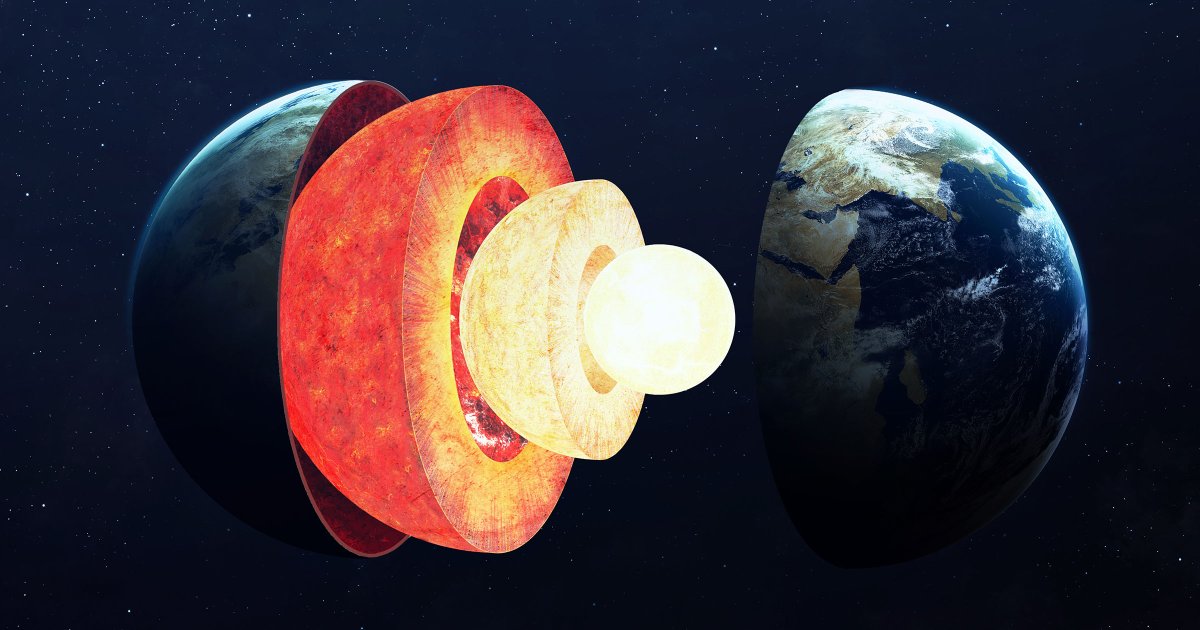
Sign up to see the future today Unmissable innovations from the cutting edge of science and technology Drilling thousands of kilometers into the Earth to study our planet’s inner layers – its thin crust, rigid mantle, liquid outer core, and solid inner core – is simply not feasible given technological limitations. Instead, geologists often use clever tricks to explore our planet’s interior, such as probing seismic activity caused by the dynamics of these shifting layers to probe its mysteries. And like these layers, that image continues to evolve. As detailed in a new study published in the Journal of Geophysical Research: Solid Earth, researchers from the Chinese Academy of Sciences analyzed data from more than two million earthquakes across the planet that took place between 1990 and 2024, using a machine learning algorithm to identify structures hiding several thousand kilometers below the surface. They identified nearly 175,000 “PKP precursors,” mysterious seismic signals that reach earthquake detectors before the main event, which may allow scientists to map Earth’s innermost structures. More specifically, scientists believe the precursors are triggered by “small heterogeneities” just above the region where Earth’s solid mantle meets its liquid iron core, about 1,800 miles below the surface. While identifying these precursors “has traditionally required painstaking manual screening, a slow and laborious process,” the researchers noted, the new algorithm allowed them to identify “approximately ten times more” PKP precursors “than all previous studies combined.” With this data in hand, the scientists set out to create what they claim to be the “most comprehensive global map to date of possible small-scale heterogeneities in the Earth’s deep interior,” including six new areas that “host significant heterogeneities that have never before been documented.” “While previous studies could only identify sparse, isolated patches where precursors were sampled, our results reveal that these potential heterogeneities can extend to broad regions in the form of continuous bands,” the researchers concluded. Scientists suggest that these ancient structures (six larger clusters spread across the globe’s interior, as seen in the image above) could be related to subduction zones, where material pulled far below the surface is chemically altered by the extreme pressure and temperature of the core-mantle boundary. As Science Alert points out, this can encourage the material to take on very different physical properties. The data could help us identify the timing or severity of future seismic activity and bring us one small step closer to unraveling the mysteries surrounding the formation of Earth’s various layers and how tectonic plates formed. More on Earth’s layers: Scientists say they detected something huge moving inside the Earth