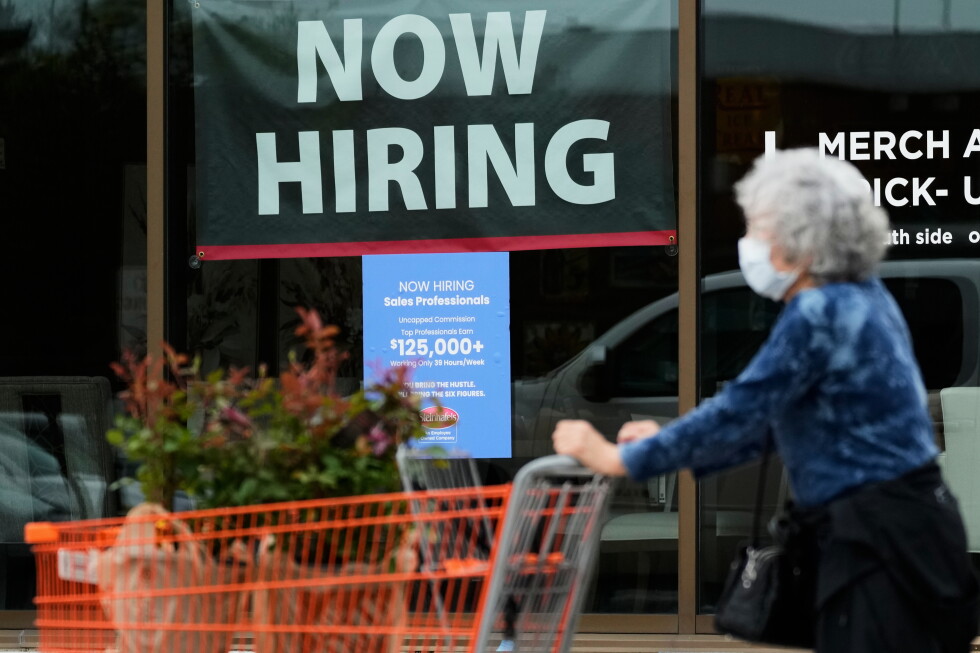
WASHINGTON (AP) — President Donald Trump has spent 20 months promising that the United States was on the cusp of an economic boom. But Friday’s surprisingly positive jobs report ultimately sparked frustration on Trump’s part. The August jobs numbers could have been a welcome break after months of slow hiring and inflation concerns that have been weighing on Trump and his party two months before Election Day. But speaking from the Oval Office, Trump launched into a whining session about inflation and interest rates. Their ire was directed at financial markets, the Federal Reserve and America’s trading partners. He opposed the commonly accepted notion in economics that the surprise creation of 162,000 jobs in August could contribute to inflationary pressures. “Success doesn’t cause inflation. Stupidity causes inflation,” Trump said in the Oval Office, declaring that it was “crazy” that stock markets fell on Friday due to concerns about inflation. “When he wins the election, we will immediately begin a new Trump economic boom,” Trump said at an August 2024 rally in North Carolina. But so far, the economy has grown about 2% annually, slower than gains during the Biden administration. Trump attributed his inability to generate stronger growth to higher interest rates on U.S. public debt, and said on social media that the United States could retaliate by stopping trade with foreign countries. Rates have been rising in response to persistently high inflation fueled by Trump’s tariffs and oil shortages due to the Iran war. The national debt has now crossed the daunting $40 trillion threshold and 10-year US Treasury bond rates rose to 4.79% on Friday. Trump has lost some of his credibility on the economy. With promised growth yet to materialize, the president has lost some of the public’s confidence in his ability to lead the world’s largest economy. His own policies have allowed, in part, the inflation and high interest rates that he wants to blame on others. “The administration’s credibility on growth, inflation, rates, debt and deficit dynamics has been affected due to wild predictions that are not aligned with economic reality,” said Joe Brusuelas, chief economist at consulting firm RSM US. If the Federal Reserve did what Trump wanted and lowered its benchmark rate so more money could flow into the U.S. economy, the potential influx of cash could make inflation even worse and only add to his political and economic headaches. But the president questioned this fundamental concept of monetary policy. He said Friday that gross domestic product would grow “12, 13, 14, 15%” if rates were lower, while appearing to ignore inflation risks. “We could have a GDP that would break all records,” Trump said. The president’s approval rating on the economy was a modest 32% in mid-summer, according to a poll by The Associated Press-NORC Center for Public Affairs Research. The last time Republicans faced midterm voters in 2018 under Trump, their economic approval rating was at 50%. Trump’s threat to cut foreign trade could jeopardize growth, further hurting its indices. His recent imposition of tariffs against Canada has become an issue for Republicans in Senate races in Maine and Michigan. Subscribe to Morning Wire: Our flagship newsletter breaks down the day’s biggest headlines. Trump advisers see a brighter future thanks to artificial intelligence, tariffs and tax cuts. Trump officials say his policies are working as intended. They say the development of artificial intelligence will lead to greater productivity to drive growth. They say last year’s tariffs should ultimately bring more factory jobs to the United States, while Trump’s tax cuts will create more business investment and his administration’s efforts to identify fraud will generate savings for taxpayers. “I expect further growth,” said Christopher Phelan, chairman of the White House Council of Economic Advisers. “We’re doing things to make good things happen.” Phelan said recent job gains have been about twice what is needed to match population growth. He considers it entirely possible that productivity gains could boost overall growth over the next few years, even as he acknowledged that growth alone may not be enough to solve all of the country’s financial challenges. Because Social Security and Medicare costs are rising faster than revenues, growth alone is unlikely to significantly reduce budget deficits. Growth is not enough to solve budget deficits. If U.S. economic growth could exceed 3% annually over the next decade, that alone would be enough to stabilize the government’s already high debt load, according to an analysis by Ernie Tedeschi, head of economic research and insights at Stripe, the financial technology company. Tedeschi said he would be “delighted” if AI could help generate those kinds of profits for 10 consecutive years, but history shows that such a large growth due to advances in computers was probably “wild.” optimistic.” “We should not be planning for an optimistic scenario at all,” Tedeschi said. Until the president’s comments on interest rates on Friday, the Trump administration spent the past week trying to make voters feel more confident about the economy. Treasury Secretary Scott Bessent specifically touted the benefits of stronger growth at the G20 summit to finance ministers in North Carolina. Commerce Secretary Howard Lutnick did so as well as part of the G20 meetings on innovation. Still Thus, Bessent told the AP in an interview that he is also working with White House budget director Russ Vought to announce a plan to “reduce the level of debt and the deficit.” Reducing the trajectory of budget deficits would likely help with interest rates, but there could be political weaknesses in the form of spending cuts and tax increases. Brusuelas, chief economist at RSM US, emphasized that Trump would probably need to make sacrifices to significantly address the debt and provide relief. to financial markets. “We need a period of slower growth in government spending, including an overall reduction in spending plus tax increases that would reduce deficits and interest rates,” he said.