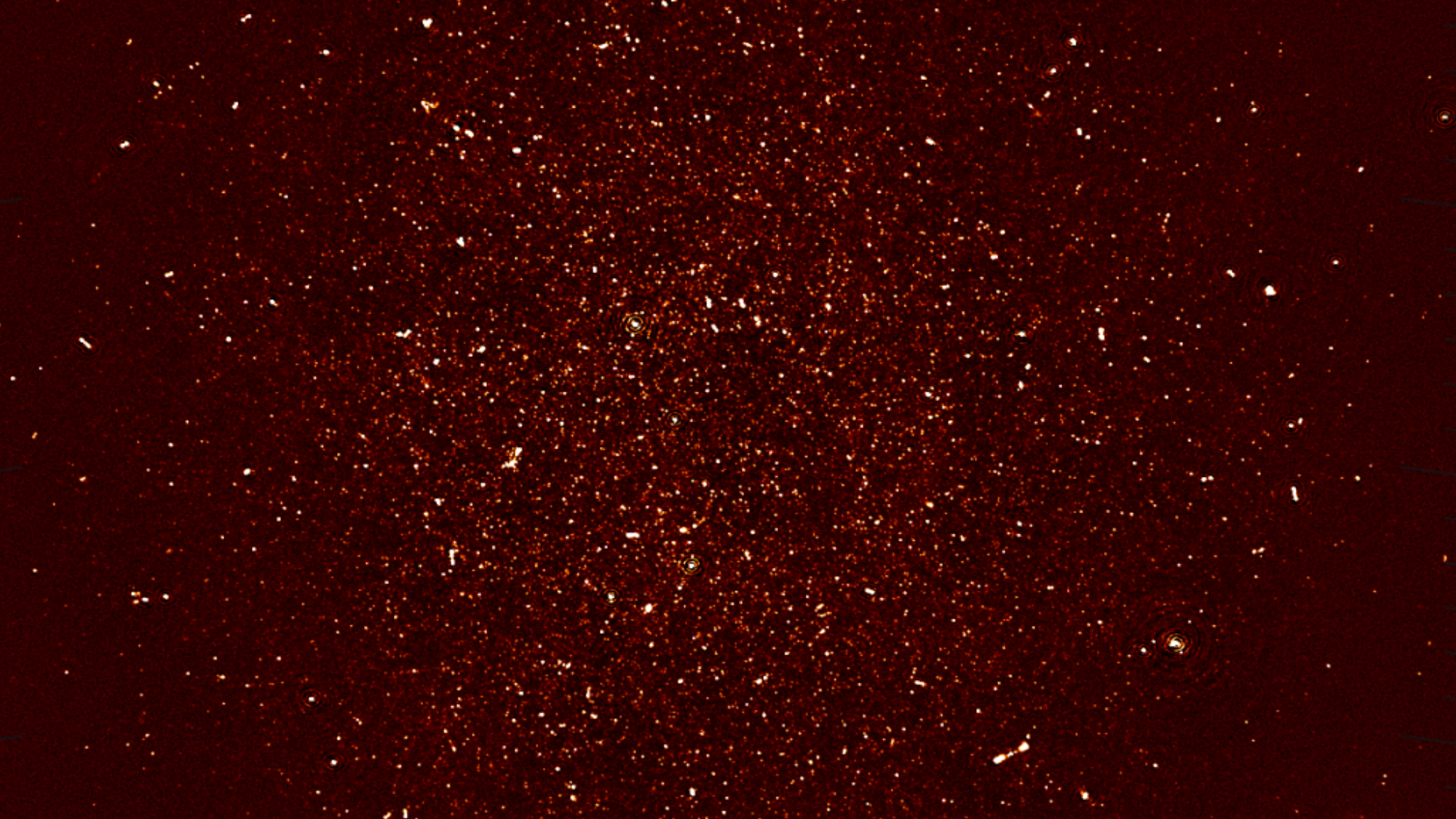
Astronomers have used the MeerKAT radio telescope to detect hydrogen gas billions of light years away from us, from a period when the cosmos was billions of years younger than its current age of 13.8 billion years. The research may provide astronomers with a new way to map the large-scale structure of the universe. The technique would be based on mapping where hydrogen, the lightest and most abundant element in the universe, is found throughout the cosmos. It is known as hydrogen intensity mapping. Neutral hydrogen emits a weak radio signal that astronomers call the 21-centimeter line. As the cosmos expands under the influence of dark energy, the wavelength of this radio signal stretches or “redshifts.” The extreme redshift allows astronomers to determine how long a particular signal has been traveling toward us, and therefore in what period of the universe the hydrogen that emitted it existed. Using the 21-centimeter line, hydrogen intensity mapping allows astronomers to track radio emissions from hitherto invisible galaxies and build a 3D image of the largest structures in the universe. Until now, however, this technique has relied on combining radio wave detection with observations from galactic surveys that work with visible light or electromagnetic radiation that our eyes have evolved to see. This new research challenges that trend, building a hydrogen intensity map using radio waves detected by the MeerKAT radio telescope, comprised of 64 antennas in Meerkat National Park in South Africa’s Northern Cape. “This is a very exciting milestone,” team leader Sourabh Paul said in a statement. “Hydrogen intensity mapping has long been considered a promising way to efficiently map the universe, but the signal is extremely weak and difficult to isolate from foreground emissions, man-made radio frequency interference, and instrumental effects.” Detecting it directly with MeerKAT shows that this technique is becoming a practical tool for cosmology. It spans distances of many millions of light years, similar to the distance between the Milky Way and our neighboring galaxy, Andromeda. The achievement represents a step forward in the utility of hydrogen mapping. “Neutral hydrogen is one of the key ingredients for understanding how galaxies form and evolve,” Zhaoting Chen, a team member from the University of Edinburgh, said in the statement. Instead, we can measure the collective hydrogen signal in large cosmic volumes, giving us a new way to study both the evolution of galaxies and the distribution of the universe’s underlying matter. Credit: SKA South Africa) “MeerKAT continues to open new windows for cosmology,” Laura Wolz, a team member at the University of Manchester in the United Kingdom, said in the statement. “The fact that this signal can be extracted from observations that were not originally designed to map hydrogen intensity is very encouraging. It shows the enormous scientific value of the MeerKAT data and points the way to future observations with SKAO. “The team will now focus on collecting more observations with MeerKAT that cover larger areas of the sky for longer periods of time. This should provide astronomers with even more detailed hydrogen maps that could, over time, help understand how the largest structures in the cosmos took shape over billions of years of measurement,” team member Mario G. Santos of the University of the Western Cape, Australia, said in the statement. “It is particularly notable that the data used in this study was taken in 2018, when MeerKAT had just begun its scientific operations. “There is now a rich trove of MeerKAT data waiting to be explored with this method.” The team’s research was published in the July issue of The Astrophysical Journal Letters.