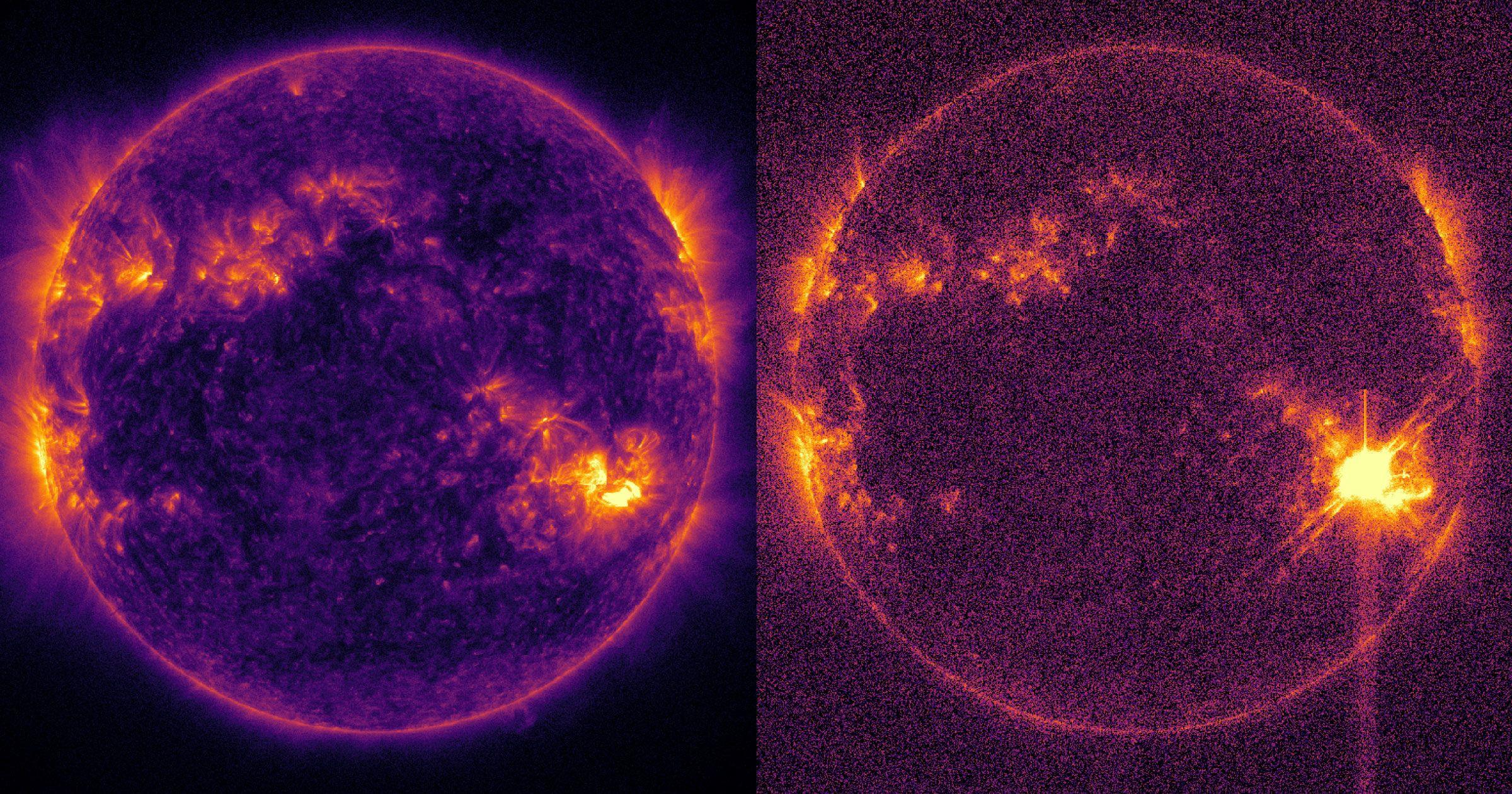
New research maps show where a severe solar storm could strike. See if your neighborhood would lose power. By Kasha Patel and Sam Hart Published September 4, 2026 Forecasters knew something unusual was hurtling toward Earth. Three days before a solar storm arrived on May 10, 2024, they watched as a dark knot on the sun — tangled magnetic field lines spanning 124,000 miles — took aim at the planet.“That’s magnets twisting and turning and popping through each other,” said Shawn Dahl, service coordinator at the Space Weather Prediction Center operated by the National Oceanic and Atmospheric Administration in Boulder, Colorado. “Think about a rubber band, twisting it and bending it and stretching it. It’s going to break.”When a sunspot snaps its magnetic rubber bands, it can send extra bursts of energy and plasma toward us. These solar storms sometimes harm electric grids and radio communications. The May 2024 incident — known as the Gannon storm — recalled memories of the Carrington Event more than 150 years ago. Considered one of the most intense solar storms in human history, the September 1859 episode disrupted telegraph systems worldwide.Gannon was three times less intense, but still the first severe solar storm to test our modern realm of satellites, electric grids and digital technology. Its impression felt like a bullet dodged. While the four-day storm stopped short of creating power outages in North America, farmers in at least 12 states had to stop planting their crops because of damage to precision GPS sensors. That alone resulted in $500 million to $1 billion in economic losses.New research offers a map of what would happen if the next storm took a more powerful turn. The study, published Friday in AGU Advances, depicts the most advanced picture yet of how a rare but massive solar storm could affect some US industries and electric systems more than others.Impacts on the East Coast During a 250-year solar storm, the East Coast would have widespread potential for grid failure. Chance of grid failure 0% 25% 50% 75+% Oughton, EJ, Bor DK, et al., AGU Advances, 2026. NASA’s Black Marble nighttime lights product. Data analysis provided by Dennies Bor/George Mason University.Researchers modeled what a Carrington Event — a 1-in-150-year geomagnetic storm or even rarer — could mean for the modern day. They estimate the US economy would lose about $1.5 billion to $2 billion per day from direct and indirect costs, as millions of people face power outages. The findings show the most vulnerable areas are the Northeast and the Northern Plains, especially locations at higher latitudes.No one knows when the next big storm will hit. While the most severe geomagnetic storms are labeled as once-in-a-century or rarer, these events don’t follow a fixed schedule.“That timing only averages out on very long timescales,” said Anna Kelbert, a geophysicist at the Harvard-Smithsonian Center for Astrophysics, who was not involved in the study but previously studied solar storm effects on power grids. “The event can occur at any time, as soon as a week from now, or centuries later.”The Gannon storm left mostly a legacy of beauty instead of destruction. Sky-gazers were treated to auroras across all 50 states, tropical locales such as the Bahamas and India as well as in Chile and Australia. Electronic fallout was also largely avoided because forecasters like Dahl provided forewarning to electricity grid operators.But Dahl said the sun is now coming down from a period of heightened activity, which is also when some of the biggest storms to hit Earth have occurred in the past.“We still need a lot of work to be ready for something that could be three times or even more powerful” than the Gannon storm, Dahl said.Where the lights go outFour decades ago, no one had a strong inkling what would happen to a power grid during a massive solar storm. Then at 2:44 a.m. on March 13, 1989, a powerful punch of solar particles shook Earth’s magnetic field and knocked out power to Quebec, Canada, and its surrounding areas. Within 90 seconds, 6 million people were left in the dark for nine hours. In the US, the storm tripped capacitors and damaged two substations on the East Coast, but the country was spared from power outages.The 1989 storm was a wake-up call — and the last time a wide blackout occurred from a solar storm in North America. That episode was stronger than the Gannon storm but far weaker than the Carrington Event.“We haven’t really seen events like this size in the modern era, where we’ve had all of this high technology and we’ve had the power grid of this size,” said Ed Oughton, researcher at George Mason University and lead author of the new study.As part of the work, Oughton and his colleagues modeled how electric currents induced by massive solar storms could flow across the country’s high-voltage transmission lines.When a solar storm hits Earth, it rapidly changes the planet’s magnetic field — inducing electric fields in the ground, said Dennies Bor, a study co-author at George Mason University. The field drives currents through grounded transmission lines and electrical devices called transformers, which help transfer energy over long distances on the grid. The extra current can interfere with the normal operations of the transformer and push it to operate in an unbalanced state, requiring more power than normal to maintain voltage. If the grid cannot supply enough power for demand, the voltage falls. Parts of the grid may disconnect to prevent equipment damage, leading some circuits to go offline.Because the US grid’s actual structure is proprietary for security reasons, the team used engineering models to create various network and transformer setups including the 10,464 substations and 16,256 transmission lines found across the country.What’s your vulnerability during the worst solar storms? Factors like electric grid density and the type of rock underneath you can paint researchers a picture of what your risk might be during an intense solar storm. 100-year storm1989 storm150-year storm250-year storm Chance of grid failure 0% 25% 50% 75+% US population at risk of grid failure: 5.1 million Note: Risk is estimated based on the given location’s nearest electric grid substation and its vulnerability to a solar storm. Sources: Oughton, EJ, Bor DK, et al., AGU Advances, 2026. Data analysis provided by Dennies Bor/George Mason University.The risk differs by region, based in part on geology and location. The East Coast and Northern Plains were the most susceptible to solar shocks because the underlying bedrock is highly resistive. It doesn’t allow electric currents to dissipate to the Earth’s core, Oughton said. As solar particles flow through Earth’s poles, high latitudes are generally more exposed to geomagnetic disturbances.The grid structure also contributes to higher risk in some areas. For instance, the eastern US is linked together in a single grid interconnection. A voltage issue in Maine, if not isolated early, could cascade through the grid to Washington, DC. The West works similarly, whereas the Texas interconnection operates mostly within the state.Risk can change also from region to region depending on the local power grid structure, which helps route electricity through the grid. If a transformer is damaged at a hub, the surrounding area will be affected. Power is restored over time depending on any alternative electrical paths that could bypass the substation or availabilities of spare transformers, for instance.“This nationwide analysis shows that we are currently ill-prepared to face a major magnetic storm, and that the societal impacts would be catastrophic,” Kelbert said.But the grid isn’t defenseless. Grid operators must manage the system when a storm arrives.How to save a power gridA Carrington-level event today won’t send the nation back to the Stone Age, but many people will feel the consequences. The study estimates power disruptions for 5.1 million people and 135,000 businesses. The financial burdens would cross sectors, with manufacturing, education and entertainment bearing the heaviest losses.The outages could last from hours to days to weeks depending on the damage and resources available to get back online, said Oughton.Strong solar events could cause billions in economic losses A 250-year storm could bring nearly $2 billion in total losses per day in both direct impacts and downstream supply-chain impacts, according to estimates by the study. The geographic analysis of the power grid finds which sectors of the economy would be most at risk in the event of various severe solar storms. 100-year150-year200-year250-year 250-year storm Finance & real estate $338MEducation & recreation $265MProfessional services $222MUtilities & construction $66MTrade & transportation $35M Bars show estimated total economic loss per day by sector (mean estimate). “Indirect” impacts are projected estimates of economic impact down the supply chain.Source: Oughton, EJ, Bor DK, et al., AGU Advances, 2026.The new estimate isn’t as apocalyptic as previous estimates. One infamous report, released in 2008 by the National Academies of Sciences, Engineering, and Medicine, said power disruptions could last from 4 to 10 years, while a widespread blackout could cost $1 trillion to $2 trillion in the first year. Another 2013 study estimated tens of millions of people affected for potentially years, too.The expensive yearslong blackout doomsday scenarios aren’t too realistic though, said engineer Mark Olson, who manages the reliability assessments for the North American Electric Reliability Corporation (NERC) that makes sure the continent’s grids work effectively. Those scenarios assumed the entire grid would collapse and fail to restart due to damages to transformers, which serve as the backbones of grids and help send electricity across transmission lines.Instead, he said, a more realistic scenario involves the overloading of transformers, which would cause circuits on the power grid to trip.“The transformer damage scenarios are generally overblown because transformers are more resilient,” Olson said. “Voltage control and instability (are) the biggest concern. That is what can lead to the system blackouts and having the economic impacts.”Even if a blackout occurs, Olson said NERC has prepared plans that are supposed to bring the system back up in 24 hours, given no equipment is damaged. This image of the United States at night is a composite assembled from data acquired by the Suomi NPP satellite in April and October 2012. The image relied on the satellite’s “day-night band” of the Visible Infrared Imaging Radiometer Suite (VIIRS), which detects light in a range of wavelengths — from green to near infrared — and uses filtering techniques to observe dim signals such as city lights, gas flares, auroras, wildfires and reflected moonlight. (NASA Earth Observatory)When the Gannon storm hit in May 2024, Dahl and his colleagues at the Space Weather Prediction Center took the unprecedented move to preemptively alert grid managers like Olson based on the computer simulations — providing six hours for sweeping grid preparations. Had they waited until the storm came closer to be observed by satellites near Earth, grid operators would have had only 30 minutes or so before it arrived to prepare the grids.After the storm hit Earth, electric currents across the North American grid remained elevated for around 36 hours. NERC recorded the highest peak levels since 2013 from Wisconsin.But Olson said grid operators across North America had already fortified the system. They configured the grid to push more power, added extra generators, cancelled maintenance of transmission lines and brought those under construction back online. Some generators went offline as a few transformers overloaded, but NERC reported no blackouts.The power grid is expected to withstand solar storms around two to three times more powerful than the Gannon storm, Olson said. Above that point though, the transformers may start faltering because they aren’t designed to operate under such an elevated state of induced currents. Many newer transformers are designed to withstand higher conditions, but much of the grid still contains older models, which have a lifespan of 50 to 100 years and have not been optimized for the most severe solar storms.“For something stronger than a 1-in-100-year event, we’re looking at a system that’s going to collapse,” Olson said. The Northern Lights are seen above the Columbia River Gorge from Chanticleer Point during the early morning of May 11, 2024, in Latourell, Oregon. (Mathieu Lewis-Rolland/Getty Images)Preparing for the big oneOver two weeks this August at the Space Weather Prediction Center in Boulder, Dahl and his colleagues called in around 100 forecasters, power grid managers and industry folks to run through what to do during another large incoming solar storm. During the practice session, the 124,000-mile-wide sunspot from the Gannon storm flashed on a large monitor at the front of the computer lab.Like a flashback to May 2024, Dahl ran through the forecast model and storm risks. But now, the forecast team has better instruments and data: models predict which locations on the power grid might feel the most strain from the storm. Instead of a six-hour notice, Dahl says the center could potentially give managers around 24 hours.Yet the concerns don’t stop as humans introduce more satellites, drones and innovative technology. During the Gannon storm, nearly half of all active satellites in low-Earth orbit were affected, experiencing drag and readjusting their orbital position. Most were commercial internet satellites and experienced small degradations in service. Some drone operations were also interrupted.If we were to have a big solar splash tomorrow, Dahl said the center has a tremendous start to alert the appropriate industries. But it’s still a challenge to prepare for the unknown.“It still gives me pause when I think about the potential level of activity that we could see, and I have confidence in our abilities,” Rob Steenburgh, a space weather forecaster at the center, added. “You find out the answer when it’s happening.”