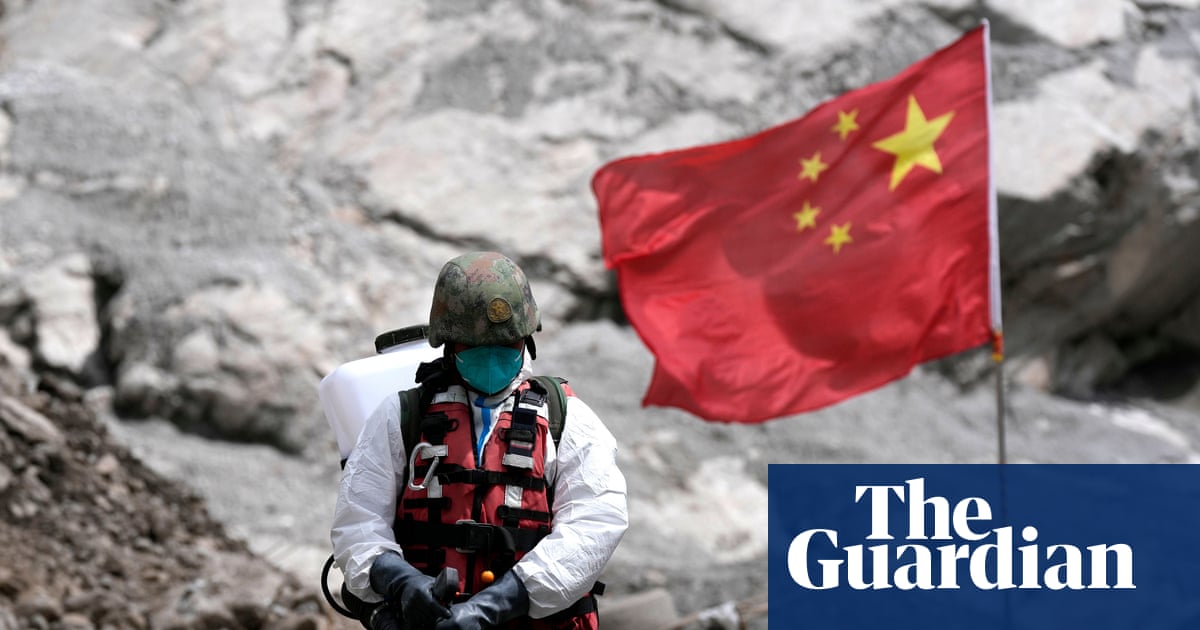
Fan Hong last heard from her husband on the morning of the Nepal-Tibet disaster. More than a week later, the 31-year-old is desperately searching for information about Lin Bo, who was working on a Chinese highway project in Nepal. Struggling to get information from authorities, Fan turned to social media for help. “My husband works on a project in Nepal, about 5 kilometers from the Gyirong border crossing. I want to know what the situation is, but I haven’t been able to reach him,” the 31-year-old woman from China’s Sichuan province wrote on Rednote. Her post has garnered more than 18,000 likes and almost 4,600 comments. She is one of many people in China with missing loved ones who are trying to piece together the information they are finding online, as Tibetan advocacy groups say information is being suppressed on that side of the border. A screen outside a shopping mall in Beijing shows a news report featuring rescue workers in Gyirong County. Photograph: Greg Baker/AFP/Getty ImagesLin began work on repairing the Syaphrubesi-Rasuwagadhi Highway, which links Nepal to Tibet, China, through the Gyirong border crossing, in 2024. He had been living on site and working on a 16km stretch of the road. Fan says rescue missions at the construction site have stalled. He says relatives of survivors are asking Chinese authorities for permission to send their own drones or helicopters to search for the missing. “Every day that passes I feel more disheartened. I feel colder and colder inside,” she told The Guardian. “I don’t even have tears left.” It’s been just over a week since a glacier collapse caused devastating floods along the Nepal-Tibet border, destroying entire villages and killing more than 1,200 people. As of Wednesday, 4,216 people were still missing, according to Nepali officials. Chinese authorities say 541 people remain missing on the Tibetan side, including 261 foreign nationals from 23 countries. The relatively low official death toll provided by Chinese authorities has also raised some concern among Tibetan advocacy groups, given the scale of the destruction seen in video footage. “All we can do is imagine, and that should terrify us,” said Tenzin Choekyi of Tibet Watch. As of Thursday, China had officially reported the deaths of 21 people. While in China, the official narrative focuses primarily on rescue efforts, online posts on Chinese social media show an emotional outpouring of grief and mourning. On Douyin, China’s version of TikTok, photos of missing border inspection officers are shared under the hashtag “Salute to the heroes guarding the nation’s entrance.” In China, families with missing loved ones say they rely on information from Nepal, as well as foreign embassies and social media. Tibetan advocacy groups say information on the Tibetan side of the border remains highly restricted. On August 30, Tibetan police reported that 10 people had been punished for spreading online what authorities called “false information” about the magnitude of the disaster. “This crackdown is obstructing not only public information about the disaster and relief efforts, but also the basic work of establishing whether communities are alive and receiving the support they need,” said Tencho Gyatso, president of the US-based Tibetan advocacy group International Campaign for Tibet. (ICT) “Sources are now afraid to speak to outside groups, including the ICT. One source told ICT it was “extremely unsafe” to speak. Another asked us not to make further contact given the possible ramifications,” he said. Gyirong held a press conference after the Nepal-Tibet disaster. Photograph: China News Service/Getty Images One fan says it is based mainly on information from Nepal. “Everyone seems to have forgotten about the workers of the Syaphrubesi-Rasuwagadhi expressway project… All the news coverage is about the hydroelectric plant [in Nepal]Families of foreign tourists missing in Tibet are also desperately seeking information, Sridhar Avvari. Photography: supplied. British nationals Sridhar Avvari, 43, his wife Deepti, 41, and son Abhinav, 14, went missing near the Gyirong immigration zone on August 26, near the Nepal-Tibet border. The family lives in India and their relatives believe they are on the Tibetan side. In a call to the family days earlier, Deepti Avvari told them there would be no signal but that she would talk when she returned to an area with network activity. After the flash flood, calls to Deepti’s phone stopped connecting. “There was no signal so we can’t talk… After coming down, I will call you again,” Deepti told Priyanka Rapaka, her sister-in-law. They are desperately waiting for updates. Deepti Avvari is among those missing. Photograph: Supplied “We are not receiving any information from China… We are just checking online who is rescued and… how many are dead,” Rapaka said. British citizen Neetu Goyal Tiwari. Photograph: Supplied Chinese authorities say they can now reach the main disaster area by road. According to state media, they describe the region as having an active search and rescue operation and are searching for hundreds of missing people. Naresh Goyal is anxiously awaiting news about his sister, Neetu Goyal Tiwari, a missing 51-year-old British national who flew from India to Kathmandu on August 14 to join an Isha Foundation pilgrimage. “The latest message received is that they have contacted the Gyirong immigration office. “They said they would check it.” He says he found his sister’s name on a list of missing people circulating on social media, but said he is not sure where the list originated. Getting information from the Chinese authorities has been difficult. “Every time we ask the Chinese government, they tell us they will inform us through the UK embassy,” he says. “It is very painful here. Now we have spent at least seven days and every minute we are waiting,” says Goyal.