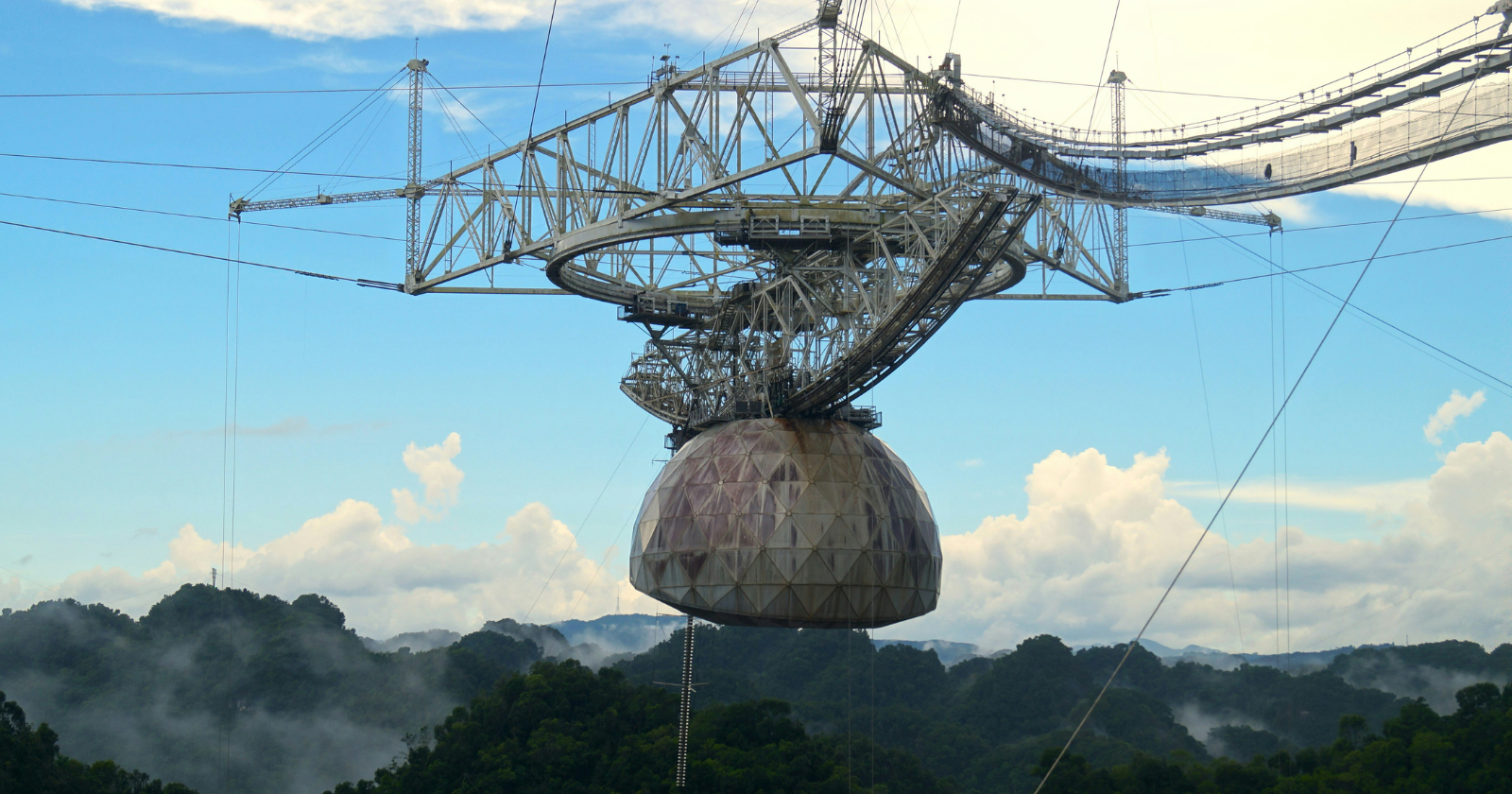
Ángel Vázquez, director of telescope operations at the observatory, was standing outside the control room on the morning of December 1, 2020 when he heard a loud bang. He looked up in time to see the rest happen. A 900-ton instrument platform, suspended 500 feet above the dish on a handful of steel cables, broke loose from one of its support towers and fell straight down. “When we looked outside the control room, we began to see the eventual fall of the observatory,” Vázquez said, adding that the entire process took about 30 seconds. Three decades of almost daily use and the end came in less time than it takes to read this paragraph out loud. What makes the story worth analyzing isn’t really the physics of the cable falling. It’s the gap between how something so big is supposed to end and how it actually ended. Fifty-seven years built a careful adjustment each time that the Arecibo Observatory was not originally built to observe black holes or distant pulsars at all. Cornell University began the project under a contract with the Advanced Research Projects Agency in 1959, as part of a Cold War-era missile defense program that studied how the upper atmosphere could interfere with tracking incoming warheads, and construction, led by Cornell engineering professor William Gordon, ended with Air Force funding in 1963. Astronomy came later and ended up mattering much more than the original mission. The observatory opened in 1963, its 1,000-foot satellite dish built directly into a natural limestone sinkhole in northern Puerto Rico because the terrain performed structural work that a flat site could not. For decades it was the largest single-dish radio telescope on Earth, and its performance was anything but subtle. In 1974, astronomers Russell Hulse and Joseph Taylor used it to find the first binary pulsar, measurements that confirmed the loss of energy due to gravitational radiation exactly as predicted by Einstein’s general relativity, work that earned them the 1993 Nobel Prize in Physics and gave physicists their first strong indirect evidence that gravitational waves were real, four decades before LIGO detected one directly. The same dish helped astronomers find the first confirmed planets outside our solar system in 1992, orbiting a pulsar rather than a normal star, and later detected the first fast, repeating radio burst ever recorded, a phenomenon that is still not fully explained. NASA also relied on it for years to track near-Earth asteroids well enough to know which ones actually posed a risk. None of that happened in a single dramatic moment. It happened through fifty-seven years of ordinary maintenance, incremental upgrades, and scientists lining up to observe time on a dish that never stopped being useful, until two weeks before it was no longer there. The cables gave all but one useful warning. The problem started smaller than the ending suggests. On August 10, 2020, one of the auxiliary cables came out of its socket in a way engineers had not seen before and slammed into the dish below, opening a 100-foot gash in the reflector and forcing the observatory to submit a $10.5 million repair request to the National Science Foundation. Engineers were still working on those repair options in November when a second main cable broke completely on its own, on November 6, at only about 60 percent of its nominal strength, a sign that something structural was wrong far beyond that cable. By November 19, the National Science Foundation had concluded that the platform could no longer be safely stabilized and announced that it would dismantle the telescope. Drone inspections over the next few days found broken wires on two more cables on the same support tower. Engineers were still working on how to carefully take down the structure when it was first dismantled, less than two weeks after the dismantling was announced. The ending that no one planned. That gap matters. NSF’s plan was for a controlled and engineered demolition, which would have allowed the antenna to survive for possible future use and allowed the people who had worked there to say a deliberate goodbye. What really happened was uncontrolled, sudden and total. The platform not only damaged the reflector, it pierced it through the center, and follow-up inspections discovered that the fall had also broken one of the observatory’s support towers near its base. Seth Shostak, an astronomer at the SETI Institute, later put the loss in stark terms: “Although life will continue, something powerful and profoundly wonderful has disappeared.” I have no technical interest in radio astronomy and I’m not going to pretend that I understood the engineering reports on cable tension that came out later. But I recognize the particular disappointment of seeing something end badly rather than well, even when the outcome, functionally, is the same either way. A relationship, a job, a project that you had planned to end on your own terms, all carry the same lesson: choosing when something ends is nothing like having that decision made for you by circumstances that never asked what you had planned. What’s in the valley now? The National Science Foundation ultimately decided not to rebuild the telescope. Instead, it committed more than $5.5 million to convert the site into a STEM education center, which began operations in 2024 under the name Arecibo C3, managed jointly by Cold Spring Harbor Laboratory and partner universities in Puerto Rico and Maryland. Its executive director, astronomer Wanda Díaz-Merced, described the change without pretending that the old telescope had not disappeared: “We will build on Arecibo’s heritage, but we will do so in a broader sense.” The plate itself has disappeared. The valley it was in, and fifty-seven years of what people learned by pointing something at the sky from within it, had apparently not yet outlived its usefulness. About this articleThis article is for general information and reflection. It is not professional advice. For your specific situation, consult a qualified professional.