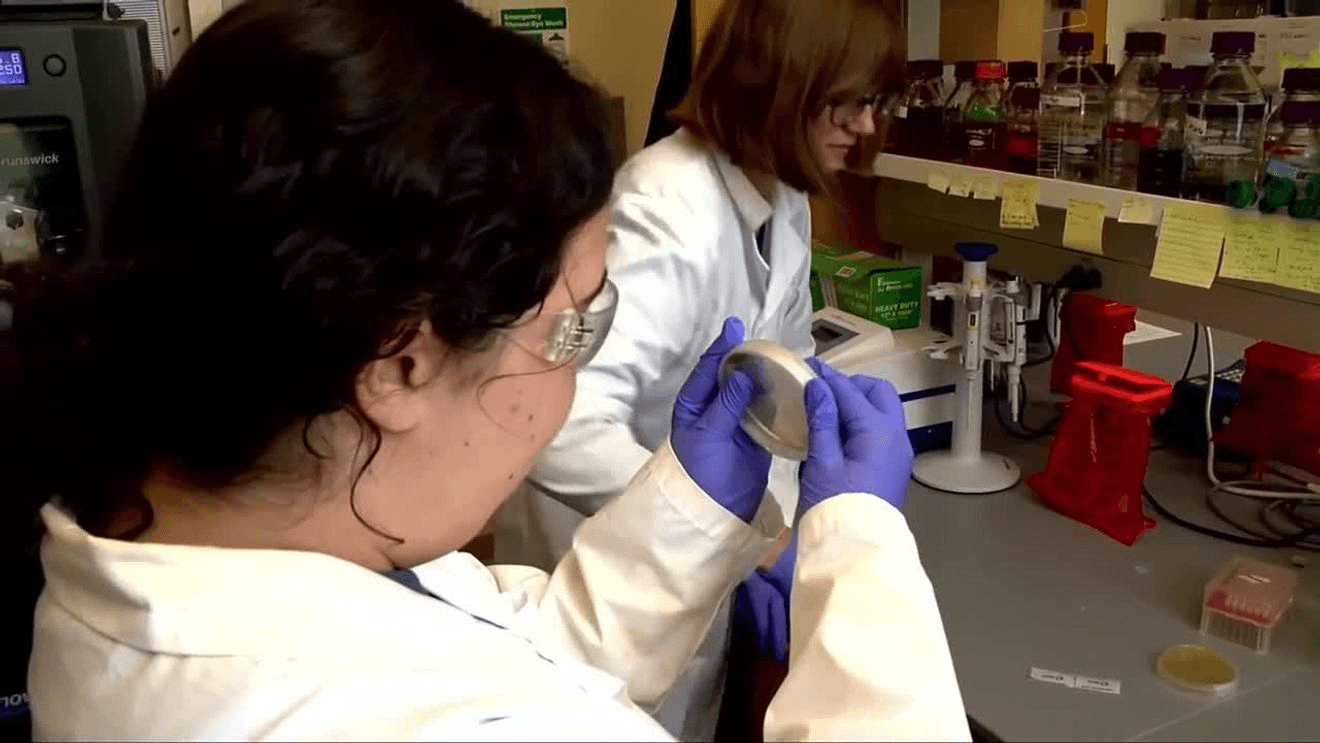
ASHEVILLE, N.C. (WLOS) — What began as an undergraduate research project at the University of North Carolina at Asheville resulted in a discovery that earned the team recognition in an accredited peer-reviewed journal. ‘It was very surreal’: UNC Asheville researchers make discovery in drug-resistant staph. (WLOS) The team discovered a weakness in a protein that drug- or methicillin-resistant Staphylococcus aureus depends on during infection, a finding that could indicate a new way to combat the bacteria. Jenna Vidaud, a recent UNC Asheville graduate, was credited as first author of the article. “I never thought something like this would happen in undergrad,” Vidaud said. “I really didn’t know these types of opportunities were available before I came to college.” UNC ASHEVILLE AWARDED $1.2M IN GRANT FUNDS FOR SENIOR ADULTS PROGRAM “Knowing what that did for the paper and what that finding did for the paper – it was very surreal,” said biology senior Garrett Davidson, another student who is part of the research team. The four-year project, led by UNC Asheville Associate Professor Melinda R. Grosser, was published Aug. 20 in the Journal of Bacteriology. Grosser said a dozen college students helped her discover a weakness in an enzyme called YqeK, which Staphylococcus aureus relies on to respond to the stressful conditions it may encounter during an infection. The researchers found that disabling the enzyme left the bacteria able to grow normally under everyday laboratory conditions, but less able to withstand hostile conditions and cause damage, Grosser said. The bacteria became noticeably less toxic, losing much of their ability to destroy red blood cells, a strong sign that they would cause milder illness during an actual infection, he said. Grosser said targeting the enzyme could lead to an antivirulence approach, one that weakens bacteria rather than killing them directly. UNC ASHEVILLE ADVANCES CAMPUS DEVELOPMENT PLANS DESPITE COMMUNITY CONCERNS bacteria,” Grosser said. “I wouldn’t pressure bacteria to develop resistance in the same way, because it doesn’t force them to fight for their lives,” he said. The research comes as antimicrobial-resistant infections continue to create a significant burden on healthcare. The Centers for Disease Control and Prevention reports that $4.6 billion is spent each year dollars in the U.S. to treat antimicrobial-resistant infections, including MRSA. Joëlla Adams, a research epidemiologist at RTI International, said the UNC Asheville research offers a promising direction for developing drugs that disarm rather than kill S. aureus, but stressed that more testing is needed before it can impact patient care. Still, Adams said approaches like this could offer an alternative to traditional antibiotics whose overuse leads to resistant infections. Vidaud and Davidson said they never expected their work to lead to such a significant discovery. They said this work is opening up even broader career possibilities for them. Vidaud is now a physician assistant after graduating last spring with a double major in biology along with chemistry and biochemistry. Davidson plans to continue the research as part of his senior thesis. additional to continue the research and determine if the findings could eventually contribute to new treatments.