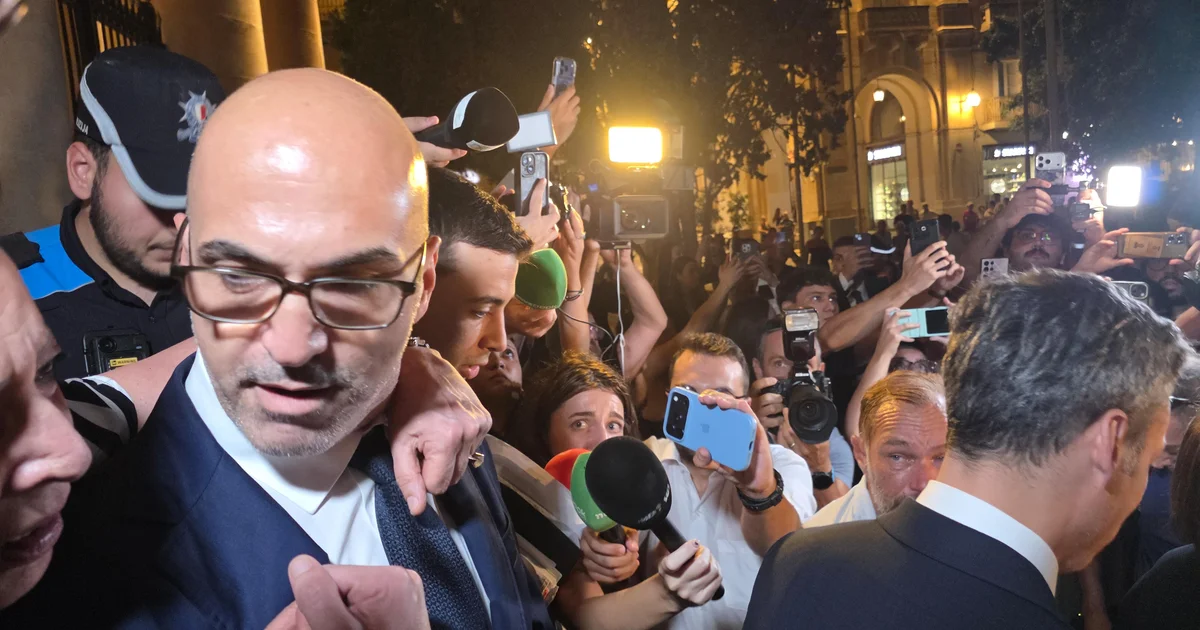
A jury in Malta on Wednesday acquitted the Maltese businessman accused by prosecutors of masterminding the 2017 car bombing murder of investigative journalist Daphne Caruana Galizia, prompting renewed calls for accountability in the Mediterranean island nation. Caruana Galizia’s murder shocked Europe, sparking protests that toppled a prime minister and exposing a culture of impunity in the European Union’s smallest state. Yorgen Fenech, a prominent Maltese businessman, was charged in 2021 with aiding and abetting and criminal conspiracy. Prosecutors accused him of masterminding the murder and of ordering and paying for it. He pleaded not guilty and the jury on Wednesday, in a vote of 8 to 1, found him not guilty of both charges. Fenech was greeted with boos outside the courtroom and the opposition Nationalist Party staged a demonstration Wednesday night to demand justice. Fenech was the last of a half-dozen people accused in the plot to be prosecuted. Maltese businessman Yorgen Fenech leaves court after being acquitted of ordering the 2017 car bomb murder of investigative journalist Daphne Caruana Galizia in Valletta, Malta, Wednesday, Sept. 2, 2026. AP Photo/Kevin Schembri Orland A woman targeted in his anti-corruption investigations Caruana Galizia, 53, was killed on Oct. 16, 2017 by a car bomb that detonated while driving near his home. He had written extensively about suspected corruption in Malta’s political and business circles, with investigative reports targeting people in then-Prime Minister Joseph Muscat’s inner circle, whom he accused of running offshore companies in tax havens revealed in the Panama Papers leak. He also took aim at the opposition and Malta’s business leaders. They called it “one-man WikiLeaks.” The former prime minister and his wife, Michelle, denied that they had companies in Panama. At the time of Caruana Galizia’s death, she was facing more than 40 defamation lawsuits. “She knew that the powerful people she was writing about were getting close to her,” Galizia’s son Paul told “60 Minutes” in 2018. “They were using every means possible to silence her. She knew it and it scared her deeply.” FILE – Flowers and a candle stand in front of a portrait of murdered investigative journalist Daphne Caruana Galizia during a vigil outside the courthouse in Valletta, Malta, Oct. 16, 2018. AP Photo/Jonathan Borg, File Her other son, Matthew Caruana Galizia, told “60 Minutes” in 2020 that he believes her gender influenced how some of the subjects in her story reacted to her work. The family had long insisted that the Muscat administration showed little interest in solving his murder. An independent investigation into the murder published in 2021 concluded that the Maltese state “has to take responsibility” for the murder due to a culture of impunity emanating from the highest levels of government. A report released by the investigation said it found no evidence of direct government involvement in Galizia’s murder, but that it created a “favorable climate” for the journalist to be killed. Case forces prime minister to resign Fenech, one of Malta’s richest people, was involved in a consortium that won a controversial contract with the Maltese government to build a power station. His arrest in 2019, while sailing away from Malta on his yacht, sparked a series of mass protests in the country that culminated in Muscat’s resignation. Maltese businessman Yorgen Fenech leaves court after being questioned over the 2017 bomb explosion that killed investigative journalist Daphne Caruana Galizia while she was driving near her home, on November 29, 2019, in Valletta, Malta. AP Photo, File After Fenech was acquitted of all charges on Wednesday, he left the Valletta courtroom to find a chaotic scene outside, with people heckling him shouting as he walked away. One of his lawyers, Gianella De Marco, expressed satisfaction with the verdict. “We are glad that justice has prevailed,” he told reporters. He said the result showed the jury did not believe a key prosecution witness who was granted a presidential pardon in exchange for his testimony. Caruana Galizia’s children were at the forefront in demanding accountability and justice for her death. His children were in the courtroom when the verdict was read, but they left without commenting to reporters. In a statement later posted on Facebook, the family said the verdict denied Caruana Galizia the “justice she deserves.” “Nine years after Daphne’s brutal murder, the institutional failures that allowed her murder remain unaddressed and unaddressed. Lasting justice means no person should face the same risks again,” the statement said. “Our country failed to protect Daphne. We owe it to her to prevent other lives from being lost.” The opposition Nationalist Party organized a silent march on Wednesday night, saying in a statement that it respected the verdict but demanding accountability for who ordered his murder. “After years of investigations, inquiries and judicial proceedings, justice has not yet reached where it needed to go: neither for Daphne’s family nor for our country,” the party said in a statement. The government, for its part, said it had always provided the necessary support and resources for the investigation and remained committed to delivering justice. He noted in a statement that several people had already been sentenced to long prison terms in the case. No cameras were allowed in the courtroom, as is customary in Maltese criminal trials. Another half dozen people involved. In 2022, George Degiorgio and his brother Alfred Degiorgio pleaded guilty to carrying out the murder. Each of them was sentenced to 40 years in prison. In 2025, two other men were sentenced to life in prison, the maximum possible sentence, after being found guilty of complicity in murder. Jamie Vella and Robert Agius were accused of supplying the bomb that killed Caruana Galizia. Another man, Vincent Muscat, pleaded guilty in 2021 for his role in the murder and was sentenced to 15 years in prison. Police and forensic experts inspect the remains of a car bomb that killed journalist and blogger Daphne Caruana Galizia near her home in Bidnija, Malta, on October 16, 2017. STR/AFP via Getty Images One confessed middleman, taxi driver Melvin Theuma, received a presidential pardon in 2019 in exchange for testimony. The murder, and the culture it exposed, led to calls for reforms to Malta’s judicial and legal systems and greater protection for journalists. Tim Gibson, deputy advocacy director for the Committee to Protect Journalists, said Wednesday that the group would continue to seek justice. He said Wednesday’s verdict was “heartbreaking for his family, who – almost nine years after his death – are still waiting for justice. We will continue to support them and seek accountability for all those involved in his murder.” More from CBS News Go deeper with The Free Press in: