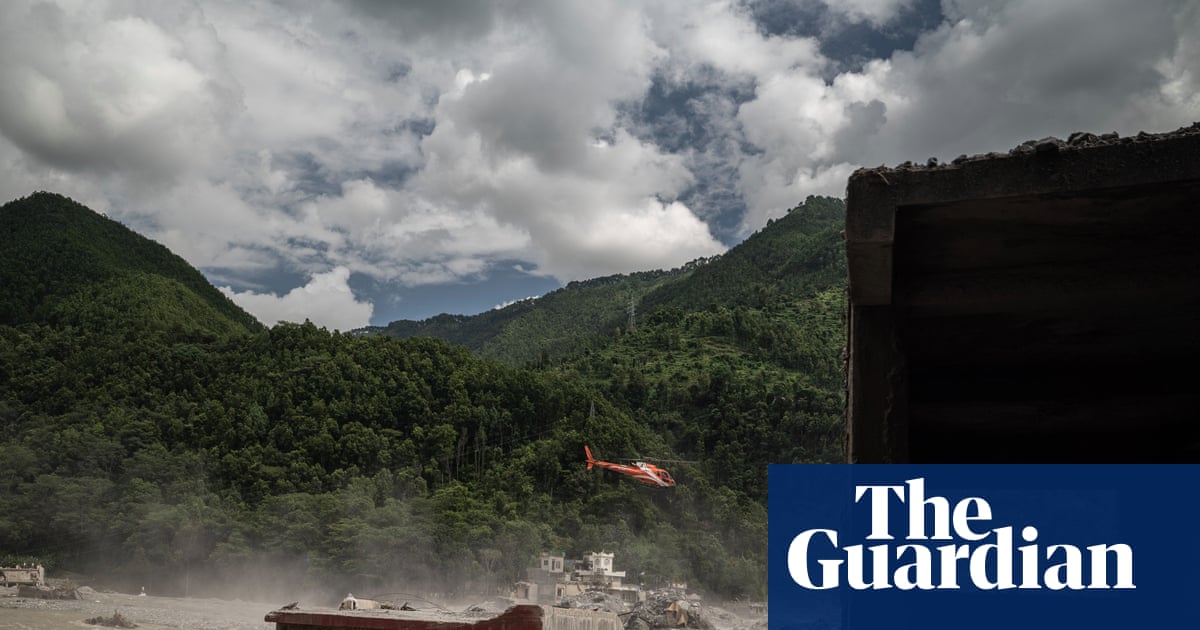
While searching for his wife’s body in the mud, Dil Bahadur Shrestha lamented that he did not even have a shovel left. For now, he’s been using his hands to try to find her as he rummages through the ruins of his house. On Wednesday morning last week, Jamuna Shrestha, his wife of 50 years, was at their home in Betrawati, on the banks of Nepal’s Trishuli River, feeding their beloved chickens and goats. Now that house remains a muddy corpse, everything inside destroyed or swept away by the violent force of the water and debris that killed more than 1,200 people in Nepal and Tibet. Dil Bahadur Shrestha, 70, had been tending his rice fields and feeding his cows on the opposite bank when he felt the ground shake and saw a black wave, hundreds of meters high, rolling down the valley. He ran to safety in the forest, but not before seeing two bridges being swept away behind him. “When it hit, everything was destroyed in two minutes,” he said. He knows in his heart that his wife is gone, but, like thousands of people trapped in the disaster, her body has not yet been found and she is counted among the missing. More than 5,000 people are missing in Nepal and another 546 in the Chinese region of Tibet. Rescuers have not yet reached Dil Bahadur Shrestha’s house, so he returned to try to recover her body himself. “Maybe he thought the flood wouldn’t reach the inside of the house,” she said, wiping away tears. The couple had already rebuilt their home once after a 2015 earthquake that killed about 9,000 people. As he spoke, his frail body collapsed on the barren, muddy ground where his neighbor’s house once stood. “Even now, I can’t believe she’s gone,” he said. “I can’t forget her. That’s why I keep looking for her. I still have the feeling that she could be walking somewhere here. I still have the feeling that she could still be here, taking care of the chickens and the goats.” The magnitude of the tragedy in Betrawati is unfathomable. It was 8:37 a.m. when a melting glacier high in the Himalayas on the Nepal-Tibet border crashed into the valley, causing deadly flash floods in Nepal’s Bhotekoshi and Trishuli rivers. At 8:50 in the morning, with only a few minutes’ warning, the settlement of Betrawati was submerged. People walking through the mud-filled river valley in Betrawati. This once-prosperous commercial city was submerged in mud so thick that only the top two floors of a six-story building are visible. Most houses were completely washed away or turned on their sides by the force of the floods. School buses are overturned. A grocery store was swept away 200 meters from its original location and lies in ruins. The river itself has been diverted into a new path that runs through where the highway once was. Fragments of the lives of the thousands of people who lived here lie scattered among the rubble: teapots, teddy bears, a log book, saucepans, packets of medicine, a couple of glasses. At least 250 people are missing, including Dil Bahadur Shrestha’s brother and sister-in-law. As Dil Bahadur Shrestha surveyed the ruins of his life, search and rescue teams remained on the opposite bank, searching for the dead. By the end of the day, 24 bodies had been removed from a single house. A helicopter hovered overhead, white body bags swinging below. “I think there could still be hundreds of bodies here,” Dil Bahadur Shrestha said. “So many people were swept away suddenly, carried away by the raging water.” His voice broke: “I’m alone now. I’m completely alone.” A few meters away, Santamaya Lawat, 57, stood shaking a thick layer of dirt from the few clothes and blankets she had been able to recover from her brother’s house, now only partially standing, with a gaping hole in the side. His own house, built just 10 months ago with his life savings, was still so full of mud that he had not yet been able to get inside. Five members of his family are gone. “My heart broke when I came back,” he said. “This was supposed to be the house I lived in for the rest of my life, but everything is gone. It was like paradise here and now it’s become hell.” Many of the villages here have been completely razed and are only accessible by army helicopters. Some are still so isolated and the ground conditions so precarious that the fate of hundreds of people is unknown. On Tuesday, police search and rescue teams confirmed that they had finally been able to begin ground operations in the border village of Timure, recovering 90 bodies so far. Map showing the extent of flooding after the glacier collapsed. Dhunche, the mountain village of Syabru Besi, was among those devastated, and even the road to the village disappeared. According to local government officials, at least 500 people are missing, a quarter of the population. The town looks like nothing more than a muddy river bed, with only one building left standing. Chhiring Dorje, a 50-year-old farmer, was one of those who managed to escape from Syabru Besi, but five members of his family are missing. “There were 15 or 16 of us from the village who managed to reach the forest safely,” Dorje said. “We stayed there for two days before the army arrived by helicopter. We had nothing to eat. We survived by drinking water from the forest.” Rescue helicopters came and went every few minutes. He said quietly that “there was nothing left where our house used to be. I went to school and I was in first grade. Now the school doesn’t exist anymore. There are no teachers either.” Chhiring Dorje, a 50-year-old farmer, was among those who managed to escape from Syabru Besi, but five members of his family are missing. With roads washed away, the only way from Kathmandu to Rasuwa is a dangerous unpaved road of mud and stones, passing through small mountain villages. The trip usually lasts more than 12 hours. The dangerous conditions have made it difficult for aid to reach the most affected areas and hampered rescue and relief operations. Many aid trucks are now stuck in Dhunche, unable to continue further north. At a small relief camp on the road between Betrawati and Dhunche, set up by Nepal’s Dhulikhel Hospital, people collected medicine and food. Doctors said dozens of children had lost their parents in the floods. More than 200 children from the local Nilakantha school, most aged between five and 11, are also missing, believed to have been swept away while walking to their morning classes. Prakash Nepal, a teacher, said the school had received a warning just 10 minutes before the flood hit, when the school bus was already picking up students. “Fortunately, we immediately contacted the bus driver and the vehicle was stopped midway so that the students could survive,” he said. “The wave of water reached the vehicle, but fortunately it did not cause much damage.” However, many of the local families had been displaced by the 2015 earthquake and were still living in informal settlements along the riverbank. Most of those children were walking to school when the flooding hit. Prakash Nepal’s eyes filled with tears: “We could not save the students who were still on the road.” A helicopter flying through the clouds over a river valley. In the midst of tragedy, there were also small stories of hope. Sitting on the porch of their home in Lachyang village, Ram Krishna Neupane, 69, and his wife, Muiya Neupane, 66, said their only son had been working as a veterinarian in Syabru Besi when the village was attacked. For the next two days they heard nothing and feared he was dead. Then they received a phone call. “He called from a hospital in Kathmandu; he had been rescued by the army,” said Ram Krishna Neupane. “He couldn’t speak, he cried a lot and we cried.” It was, his wife added, “a miracle.”