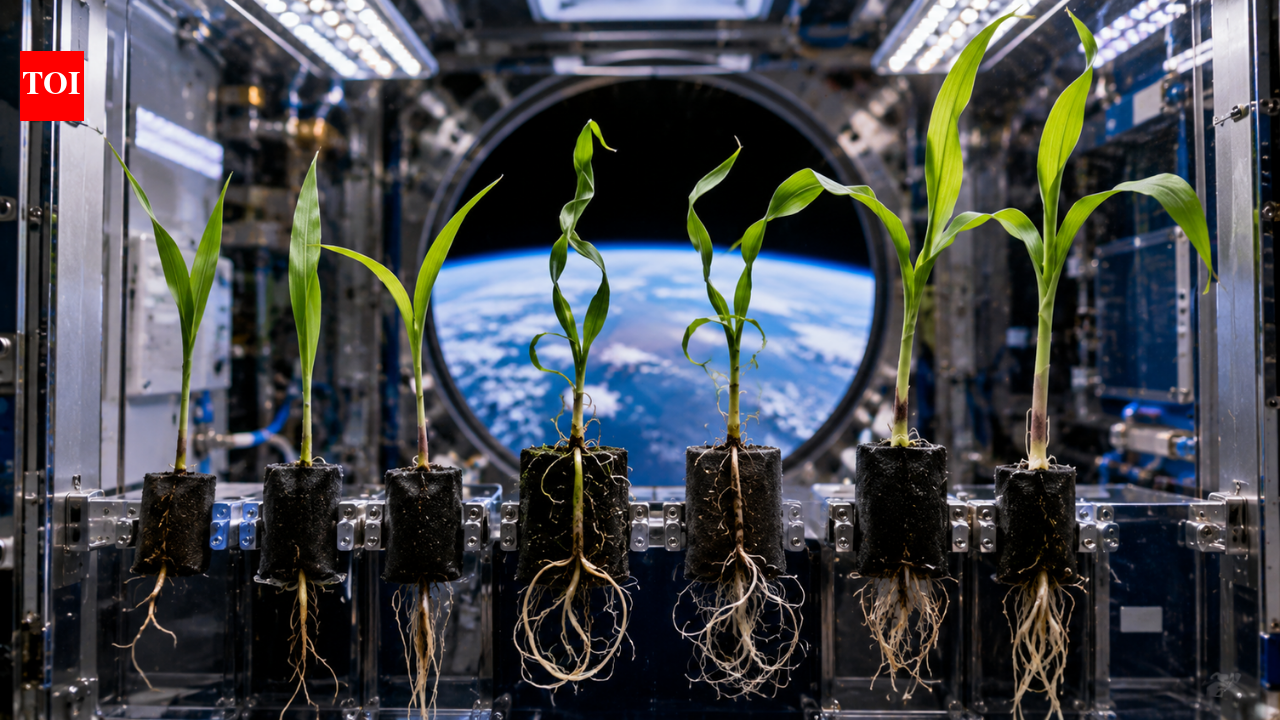
Long before astronauts plant a seed on the Moon or Mars, NASA has been testing a much simpler question here on Earth’s doorstep: What happens when a corn seed germinates without gravity telling it which direction to grow? In the early 1990s, researchers flew dried corn kernels aboard the space shuttle, let them sprout in orbit, and compared them to identical seedlings grown under normal gravity on Earth. The plants survived. His tissue looked healthy. But something was clearly missing. Without gravity to act as a compass, roots and shoots completely lost their sense of direction, growing in tangled, unpredictable patterns rather than the clean, descending, ascending paths seen on Earth. The findings showed that plants could still develop in space, but their normal growth patterns were largely dependent on gravity. This raised important questions about how future crops could be grown during long-duration missions, where reliable food production could be essential for astronauts. It’s a small but telling result, and one that NASA has continued to develop ever since, through experiments with corn and a variety of other plants aboard the International Space Station. As NASA moves closer to sustained crewed missions beyond Earth, decoding exactly how plants compensate for missing gravitational signals could prove as critical to mission survival as any advances in propulsion or life support technology. What happened to corn seeds in space without gravity? One of the clearest examples comes from a NASA-funded shuttle experiment described in a 1992 paper archived on the agency’s technical reports server, hosted at NASA’s Kennedy Space Center. The researchers imbibed dried corn kernels, placed them in orbit, and allowed them to germinate and grow for five days in the dark, comparing the seedlings to identical batches grown under normal gravity on Earth. According to NASA, the shuttle-grown seedlings developed largely as expected in terms of weight, hormone levels and tissue structure, but with one surprising exception. According to the researchers, the tissues of the shuttle-grown plants appeared normal and the seedlings differed only in the lack of orientation of the roots and shoots. In other words, the plants developed perfectly healthy tissue; They just couldn’t tell which direction to point it. Image generated by AI How does gravity guide plant growth? On Earth, gravity gives a germinating seed an unmistakable signal: the roots grow downward, the shoots grow. If that cue is removed, the seedling will have to rely on other cues, such as light, humidity gradients, or its own internal mechanical sensing, to decide which direction to grow. The corn experiment demonstrated that when gravity disappears, roots and shoots stop following a single, consistent path and instead grow in a mixture of directions, an effect popularly described as roots and shoots losing their orientation or growing in twisted, disorganized patterns instead of the straight lines seen on Earth. Crucially, NASA researchers were cautious about overinterpreting a five-day snapshot. According to the paper, the findings cannot be extrapolated to microgravity growth over weeks, months and years, the kind that might be needed aboard a future space station or Mars transit vehicle. The seedlings looked healthy for five days; no one yet knew what would happen in five months. Do other plants also lose direction in space? Corn is far from the only species that shows this type of directional confusion in orbit. NASA-funded experiments using Arabidopsis thaliana, a small plant in the mustard family that is the workhorse of spaceflight plant biology, have repeatedly documented roots that “skew,” or curve away from a straight growth path once gravity is removed. According to a 2020 study published in Frontiers, titled ‘Root Skewing-Associated Genes Impact the Spaceflight Response of Arabidopsis thaliana’, in Plant Science and conducted aboard the International Space Station, it was long assumed that this skewing behavior required gravity as a reference point, and the observation that it persists in orbit overturned that assumption. A separate NASA-supported ISS experiment, known as CARA, came to a similar conclusion from a different angle: genetic activity rather than visible form. According to the paper published in 2024 in Nature, titled “Light plays a major role in the transcriptomic response of Arabidopsis to the spaceflight environment,” plant tissue grown on the space station showed distinctive patterns of gene switching depending on whether it was exposed to light or kept in the dark, reflecting a complex, tissue-specific effort by the plant to reorganize its own growth machinery in the absence of gravity. Taken together with the corn results, the pattern across species is consistent: Plants don’t fail in microgravity, but they do lose their built-in compass. How is NASA preparing to grow food in space? The agency has built an entire open access infrastructure specifically to capture and share findings like these. The Open Science Data Repository serves as a single location for a variety of the agency’s space biological data, consolidating decades of plant, animal, and human spaceflight research from NASA’s Ames Life Sciences Data Archive and GeneLab databases into a single searchable system. This is important because NASA’s plans for long-duration missions, including eventual crewed trips to Mars, assume that astronauts will be able to grow at least some of their own food along the way. Understanding exactly how and why plants lose their sense of direction in microgravity, while still developing healthy tissue, as the corn experiment demonstrated, is a necessary step toward designing growth systems, lighting signals, or even genetic tweaks that can compensate for the missing gravity signal before crews rely on space-grown crops to survive.