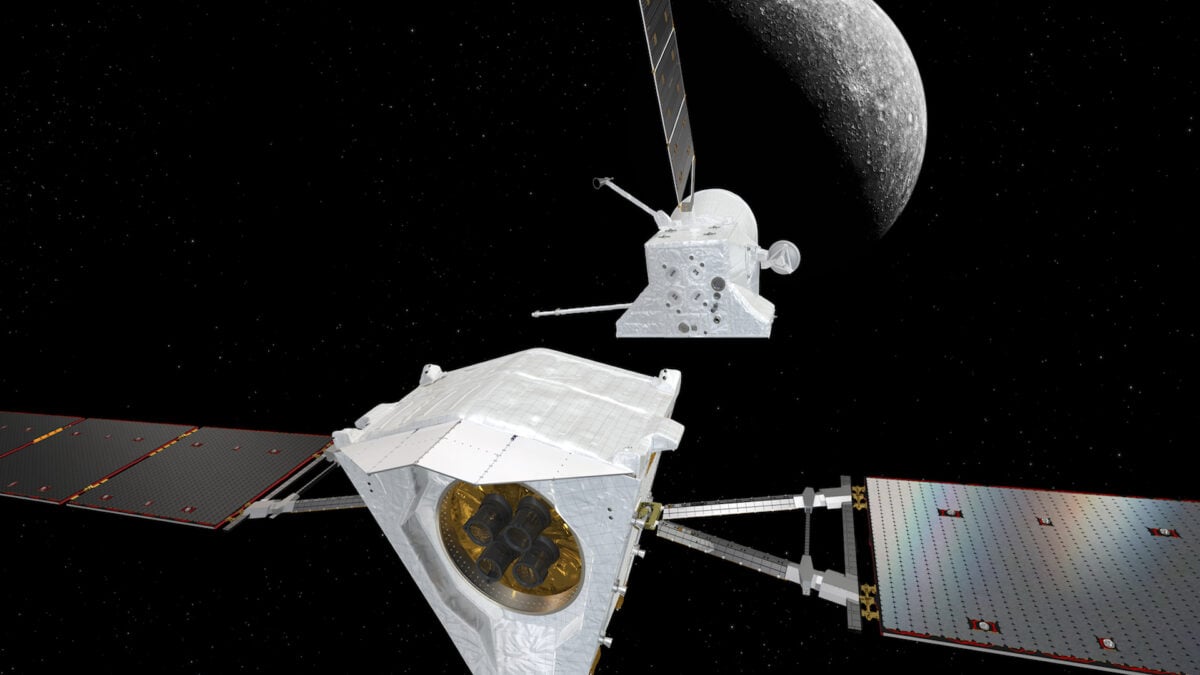
After traveling together as a joint spacecraft for eight years, the twin BepiColombo orbiters will finally be forced to separate when they reach their destination. BepiColombo, a joint mission between the European Space Agency (ESA) and the Japan Aerospace Exploration Agency (JAXA), is preparing for a challenging separation sequence that will take it from one spacecraft to two. The spacecraft’s arrival at the planet closest to the Sun will be streamed live on ESA’s YouTube channel on September 3 at 6:45 a.m. ET, and you can also tune in via the stream below. BepiColombo was originally scheduled to arrive at Mercury in December 2025, but the twin probes suffered a technical problem that prevented them from operating at full power. The spacecraft was forced to follow a different trajectory toward the planet, delaying its arrival. Separation anxiety BepiColombo launched in October 2018 on a mission to explore the surface and interior of Mercury, along with the planet’s magnetic field. The twin probes, ESA’s Mercury Planet Orbiter (MPO) and JAXA’s Mercury Magnetosphere Orbiter (MMO), were launched together in a single spacecraft, but each is designed to enter its respective orbit around Mercury later this year. After an arduous journey through space, the mission is about to begin its arrival phase at the planet closest to the Sun. On Thursday, ESA’s Mercury Transfer Module (MTM) will separate from the two BepiColombo scientific orbiters. The transfer module carried the two scientific orbiters on their journey to Mercury. However, once on the planet, the two orbiters will take off alone as a single stack moving in free fall. A timeline of BepiColombo’s arrival at Mercury. Credit: The separation of ESA MTM is the first major step towards a meticulous sequence of events designed to initiate the dual mission. After MTM separates from the twin probes, both will lock into a polar orbit around Mercury as a single stack using MPO’s chemical thrusters. In December, the MPO’s small thrusters will be used to lift the probe into orbit. There, the probe will eject its once-attached twin and spin around. MPO will then discard its sunshade and continue its own orbit around Mercury. BepiColombo is only the third spacecraft to visit Mercury, as the Sun’s powerful gravitational pull makes it difficult to reach the elusive planet. The mission carried out its first flyby of the planet in October 2021 and has provided magnificent close-up images of the smallest planet in the solar system, as well as valuable data about the mysterious orb. Yes, it was a bumpy ride to Mercury, but hopefully, it will be a smooth ride from now on.