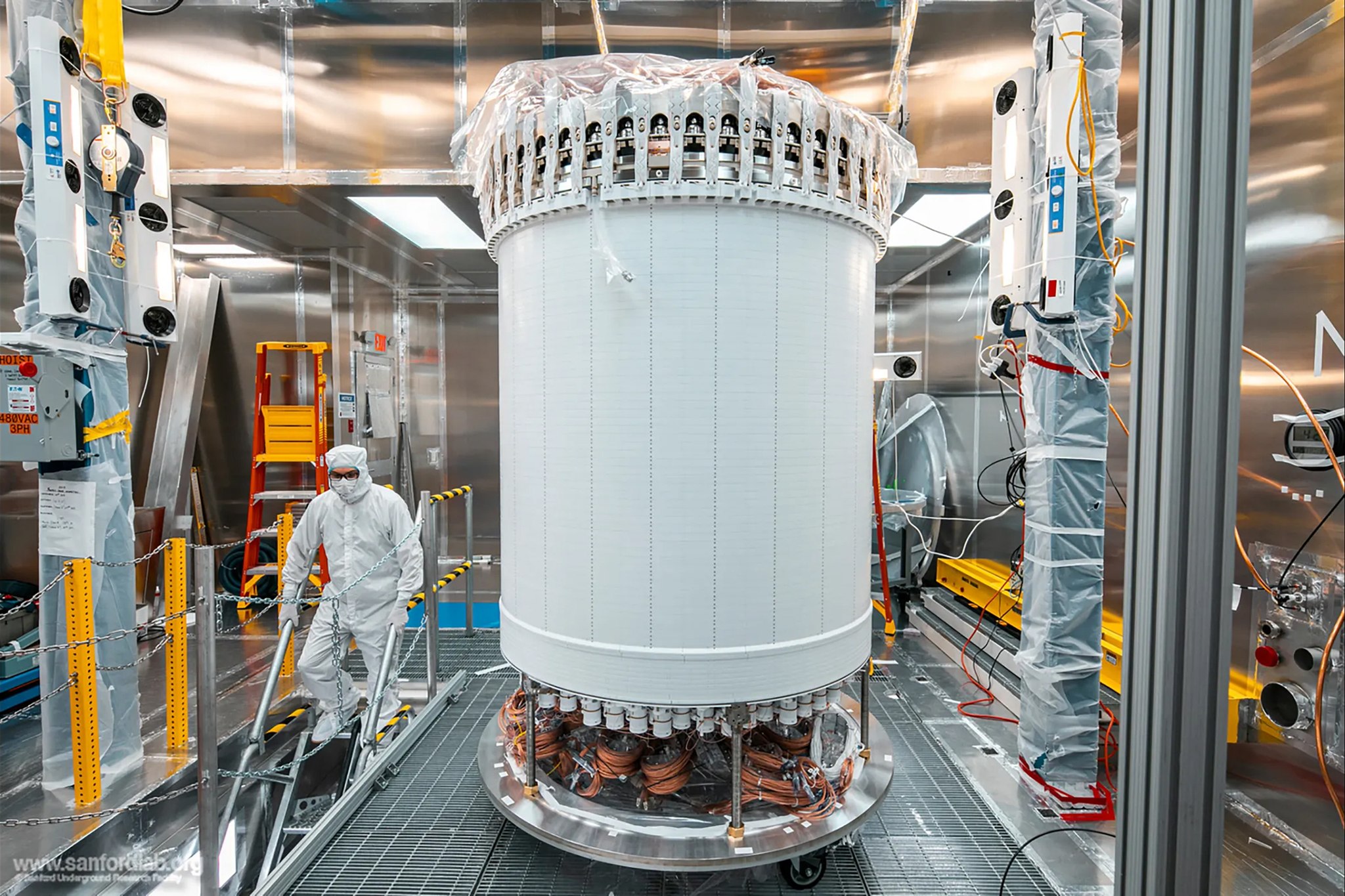
The main LUX-ZEPLIN detector in a surface laboratory before its underground installation. Researchers now report that they have found an unexplained phenomenon that could be direct proof of the existence of dark matter. Matthew Kapust/Sanford Underground Research Facility The LZ dark matter detector was placed nearly a mile underground in a former gold mine at the Sanford Underground Research Facility. The underground location protects the experiment from cosmic rays. Researchers now report that they have found an unexplained phenomenon that could be direct evidence of dark matter. Matthew Kapust/Sanford Underground Research Facility ALBANY – Cecilia Levy may have seen the wind. Four years ago, the UAlbany physics professor and 250 other scientists from 39 institutions set out to try to see dark matter. Article continues below this advertisement. They organized a 1,000-day experiment called LUX-ZEPLIN (LZ). at the bottom of a mine in South Dakota, hoping that being at great depth would filter out enough cosmic interference to clearly identify dark matter. No one has ever seen dark matter. They still don’t know what it is made of or what it is for. But it is thought to make up about 27% of the universe, and may be the force that attracts galaxies and holds them together as the universe expands, according to physicists. That would make her a very powerful force. But it seems invisible. Levy compared it to the wind: When leaves on trees rustle or waves roll over a lake, it’s an indication that an invisible force might be there. But squirrels or a thrown rock could just as easily explain the phenomenon. Subscribe to the Albany Now newsletter. Stay up to date on the latest happenings in communities across Albany County. Subscribe here. Article continues below this advertisement. She is looking for a particle interaction that would be direct evidence of dark matter. She and the rest of the team began by ruling out any interactions that could be explained by something physicists already know. After examining their data, they were left with an incident they cannot explain. “We’ve done everything we can to try to explain it, and right now we can’t,” Levy said. “So, this is very, very interesting.” Article continues below this advertisement. It’s so tantalizing that scientists made a formal announcement Tuesday morning and submitted a paper to the scientific journal Physical Review Letters. But there is a lot of space between something unidentified and dark matter. “Now, I want to be extremely cautious; it’s just an event,” Levy said of the particle interaction. “We don’t claim to have been a discovery. But we can’t say what it is. It could be dark matter.” Or, to use your analogy, they were looking at a tree while dark matter was in a nearby tree. Article continues below this advertisement. “Going back to the tree analogy, we were looking at (leaves that could move) on one tree and this event happens on another tree,” Levy said. “Actually, it’s not exactly where we thought an event would occur. It’s with much higher energy.” They haven’t finished analyzing all of their data. But they have spent two years studying this moment, trying to prove that it is not dark matter. At this point, Levy said, he wants other scientists working on their own dark matter detection experiments to weigh in. “It could tell the competition, ‘Hey guys, if you haven’t looked in that area, go check it out because you might have something,’” Levy said. “If this happens, I want everyone to be on the lookout for it.” Article continues below this advertisement. Professor Matthew Szydagis, a fellow at the University at Albany, emphasized that the data they have is not enough to prove that they have found dark matter. “This would be like seeing a very brief rustle of leaves out of the corner of your eye,” he said. “This is just one event. That’s why we have to be extremely careful. You can’t build a scientific theory on a single event. We need corroboration, reproduction.” Still, Levy is fairly certain that the “event” cannot be explained with known phenomena. “We’ve looked at it thoroughly,” he said. “We wouldn’t publish this if we weren’t sure we had ruled out other explanations.” Article continues below this advertisement. Now, see if someone else can explain it. “That’s how science works, it’s little by little,” he said. “You can’t wait until everything is finished because then nothing would ever be published.” Finding dark matter could be as big as the discovery of electricity. “When electricity was discovered, it was just a toy, just an interesting scientific phenomenon, and now it rules our lives,” Szydagis said. “We don’t even have the imagination yet to know why this would be important in practice.” Article continues below this advertisement. But if they find it, Levy said, it will be big. “Think of your children, think of your grandchildren,” he said. “They are the ones who are going to benefit from this, in ways we can’t imagine.”