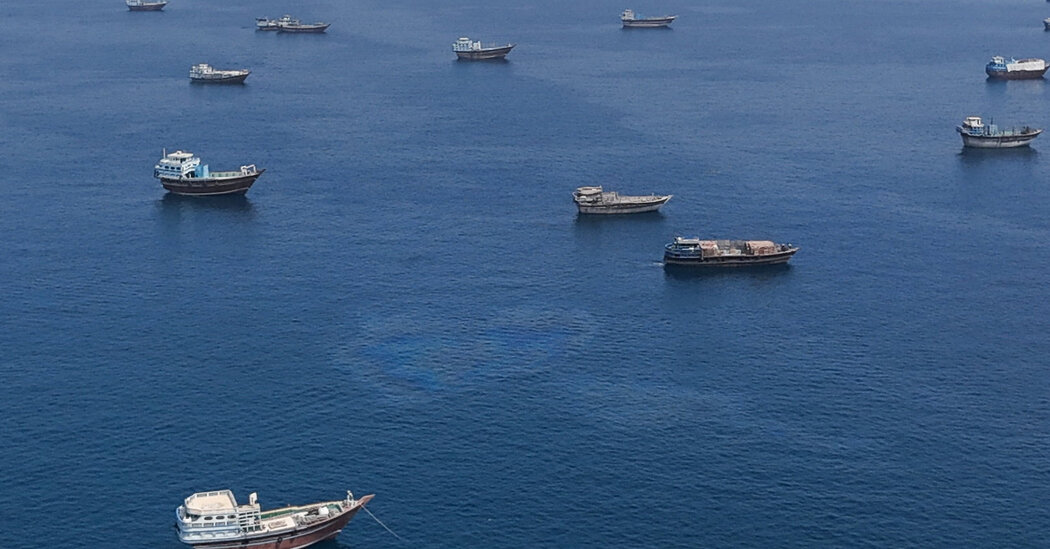
Coming back from a peaceful vacation is never easy, especially when the real world is far from peaceful. The first headline that greeted me was the exchange of fire between the United States and Iran for the first time in a month. The end of the war that began six months ago remains as elusive as ever. Many of you responded to our call for questions about the war in Iran. Thank you. Below are a few that came up frequently, with responses from my colleagues. Answers to your questions about the Iran war How far could Trump go? If he were to lose the November election, could the situation get out of control? — Flavio Nardini, Italy David Sanger, who covers the White House and national security, writes: It’s hard to know how far President Trump will go with the Iran war; he delights in unpredictability. But all recent indications suggest that, at least in the immediate future, a return to large-scale military action is unlikely. It clearly did not produce the results I expected. Now it is back to economic sanctions. But if there is a significant event – for example, an Iranian attack that kills Americans or a major cyberattack against the United States – that could change. And it seems likely that the United States will maintain a significant military presence in the region for the foreseeable future. A note on the midterms: If Democrats perform strongly and win the House or Senate, or both, investigations into the war will begin as soon as they take control. To what extent has the war strengthened the regime and weakened the opposition? — Bernd Weber, Germany Yeganeh Torbati, who covers Iran, writes: When you look at the history of Iran, it is true that the regime is most united when facing an external enemy. It is also true that authorities have carried out a wave of executions of protesters this year, often justifying them by claiming that protesters had been helping Iran’s enemies. At the same time, the government has responded to peaceful protests with deadly violence at a time when there were no external threats. My own assessment is that the threat or existence of war helps the government more easily justify acts of repression that it was already inclined to carry out. How has the war affected American power, including the credibility of its president and his ability to deter rival powers? — Pia Bungarten, Germany Steven Erlanger, who covers global diplomacy, writes: Failure raises questions, and this war has failed to achieve key U.S. and Israeli objectives. The Strait of Hormuz is now blocked and there has been no progress toward ending Iran’s nuclear program, let alone its production of ballistic missiles and drones. And the United States has failed to protect its own bases or its regional allies. As a result, American credibility has taken a big hit. The US military is unrivaled, but military power has not been linked to a successful strategic outcome. And the United States now has a shortfall in key air defense munitions, both for itself and its treaty allies, that will take years to rectify. Adversaries like Russia and China will take note. Could an international body manage the Strait of Hormuz, instead of Iran or Oman? — S. Jayakumar, India Neil MacFarquhar, who recently wrote about the waterway dispute, writes: Iran has said its future national security now depends on its control over the Strait of Hormuz. The United States doesn’t want that, but the military commitment required to reopen the strait without Iran’s consent would risk causing too many American casualties to be considered viable. One proposal being discussed, inspired by agreements elsewhere in the world, is for the eight states bordering the Persian Gulf to create a consortium to oversee operations. The consortium could charge some sort of environmental maintenance fee to some of the ships passing through, which, not technically a toll, would be legal under international law. Official Iranian media outlets have expressed interest in the proposal. How Trump might respond is anyone’s guess. What international organizations, if any, are providing support to all crews of all ships abandoned in the waters surrounding the Strait of Hormuz? — Jeff Bondett, Canada Jenny Gross, who covers trade and logistics, writes: According to the UN, the well-being of the approximately 6,000 sailors still stranded in the Persian Gulf is primarily the responsibility of the shipping companies that employ them. The result is a truly heterogeneous panorama. Some companies are making sure sailors have enough food and periodically changing crews to give them a break from the dangers and stress of working on what has effectively become a frontline. But our reports tell us that some sailors subsist on rice and lentils, and that some have not been paid for months. There are groups representing seafarers, such as the International Transport Workers’ Federation and Stella Maris, the official maritime charity of the Catholic Church. These groups contact companies to try to improve conditions on ships, but there are limits to what they can do. Some sailors are on ships that are subject to sanctions and often do not comply with maritime regulations. Crew members can request to be evacuated and flown home, but that requires the cooperation of immigration authorities in neighboring countries. And many crew members are on short-term contracts and may be reluctant to turn down a dangerous trip for fear of being blacklisted by employers. MORE TOP STORIES Principal saved 900 students in Nepal Rajendra Dawadi was teaching a class at Tribhuvan Trishuli School in Nuwakot, north of Kathmandu, on Wednesday when a staff member burst into the classroom shouting that a major flood was coming. Dawadi told the approximately 900 children present to run to higher ground. Minutes later, a deluge of water, mud and debris swept through the area and destroyed the school. “We saved lives, but now there is no place to teach students,” Dawadi said. WHAT ELSE IS HAPPENING OPINIONS The Kremlin is redefining what it means to be an author in Russia, says writer Natasha Kiseleva. Asking for help is crucial in a life or death crisis. It’s also key to success, writes Angela Duckworth. Dolly Parton represented the best of the American South, but she also knew it was a place of deep pain, writes David French. HEAVY LIFT OF THE DAY Residents of the Japanese city of Hirosaki banded together to move a 400-ton landmark. Their efforts are part of the ancient tradition of hikiya, which involves relocating buildings with rollers and ropes rather than dismantling them. Some tenacious schoolchildren joined in the action, gritting their teeth, bending their knees and singing. In a rare delirium, my colleague Dwight Garner has declared that Marlon James’s new novel, “The Missing,” is the novel of the decade, and possibly of the century. Devouring the 600-plus page epic was, he says, “one of the most important reading experiences of my adult life.” It’s out today in the US and later this month in the UK. The story is about the gay experience and murderous homophobia in Jamaica in the 1980s and 1990s. In an interview with The Times, James said that writing this was his attempt, as a gay man now residing in the US, to “face the history that I was not allowed to experience” in his native Jamaica. Read Garner’s review and our profile of James. AROUND THE WORLD Spain cools off with late dinners Spaniards have long eaten later than people in other parts of Europe, a tradition that many see as part of their national identity. Families gather around their tables for late-night dinners and restaurants stay full until after 10 p.m. But the evidence suggests that Spain is moving up dinner time. A restaurant reservation platform reports that reservations at 8:00 p.m. in Spain have almost tripled since 2019, while reservations at 10:00 p.m. have halved. The reasons for the change are not entirely clear, but one factor could be the Covid pandemic, which broke old routines. Read more about changing dining habits in Spain.RECOMMENDATIONSWatch: The film “Filipiñana” uses a golf course to explore the Philippines’ deep divisions over territory and class. Listen: British DJ, producer and songwriter Floating Points, who has a new album out, makes music for the dance floor and ballet stage. Katsu is a popular Japanese comfort food made of breaded cutlets. Serve these golden fried chicken breasts with crispy shredded cabbage, steamed rice, and a generous drizzle of sweet and savory katsu sauce.