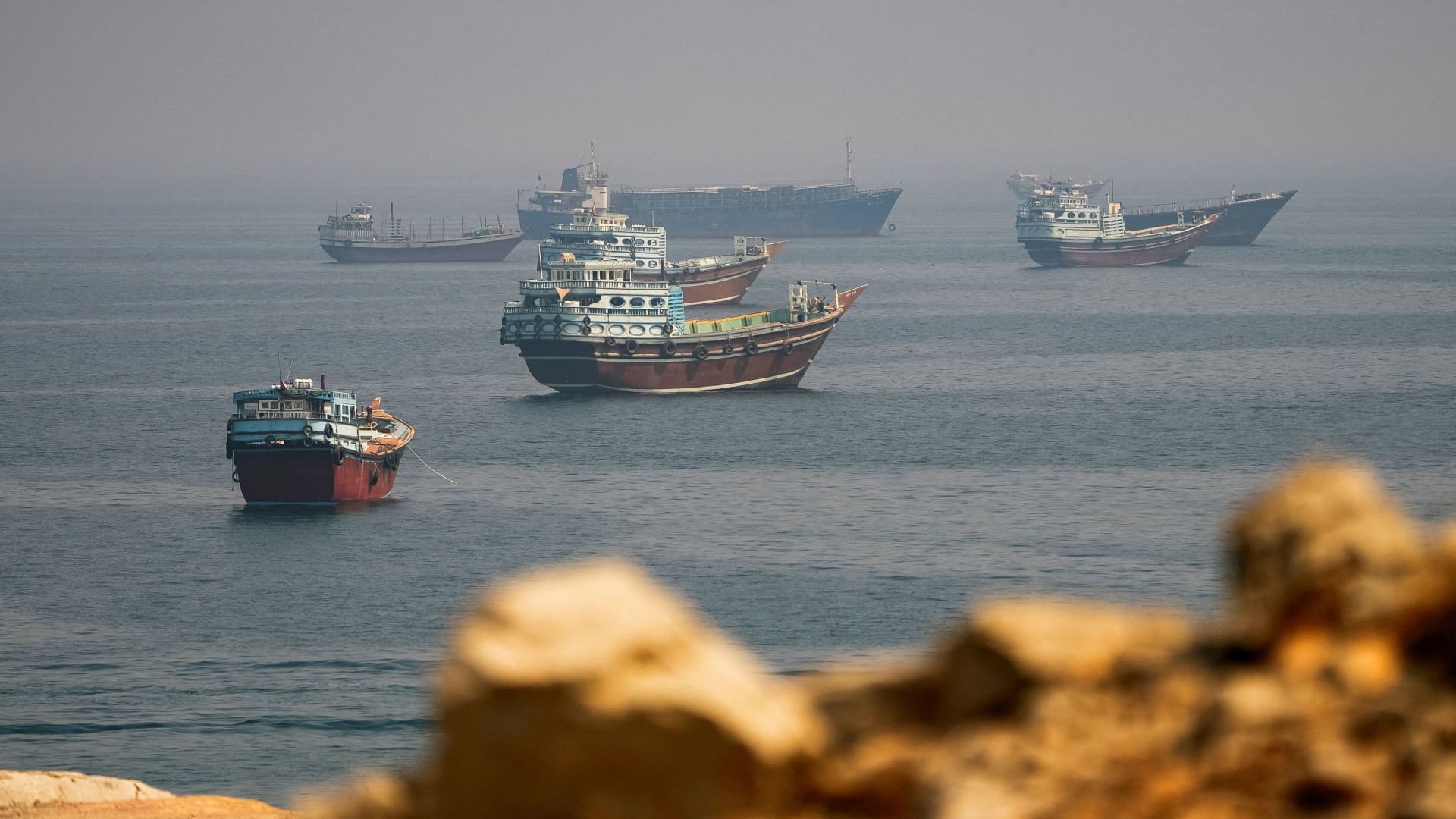
Ships near the Strait of Hormuz, as seen from Musandam, Oman, August 31, 2026. Stringer | ReutersAn oil tanker was hit by three unknown projectiles while transiting the Strait of Hormuz on Monday, fueling concerns that the conflict in the Middle East could escalate again. The tanker was sailing on the southern shipping route near the coast of Oman, the UK’s Maritime Trade Operations agency said in a post on Tuesday Asia time. No victims were reported. Iran launched an attack on two US bases in Jordan on Monday in retaliation for the US attack on its Larak island. US forces attacked two Iranian rocket launchers on Larak Island on Sunday, reportedly killing three, saying Tehran intended to launch rockets laced with sea mines into the Strait of Hormuz. The small island, located in the Strait of Hormuz, has been a critical military and maritime control point for Iranian forces, helping them maintain firm control of shipping traffic through one of the world’s most critical shipping routes. The back-and-forth hostilities marked the first time the United States and Iran exchanged attacks in more than a month. While neither side appeared to want to return to full-scale war, both signaled they were prepared to respond to new attacks. “We’re going to hit them hard,” President Donald Trump told Fox News on Monday, asserting that “there will be a response” to Iran’s attacks on US military bases in the region. Analysts largely see the US attack on Larak Island as an attempt to break a stalemate rather than a change in strategy. “By attacking the launchers rather than broader Iranian military infrastructure, the United States appears to be punishing specific behavior rather than, at least for now, expanding its war objectives,” said Ali Vaez, deputy program director at the International Crisis Group. “It’s imposing the blockade,” said Jason Brodsky, policy director at United Against Nuclear Iran, adding that the Trump administration’s goal was to further degrade Tehran’s capabilities to mine the Strait of Hormuz, while focusing on coercive economic measures as the midterm elections approached. Washington has increased pressure to squeeze Iran’s already tattered economy with “secondary sanctions” that punish nations and companies that buy Iranian crude. US Treasury Secretary Scott Bessent said on Monday, on the sidelines of the Group of 20 finance ministers’ meeting, that Iran was “attacking kinetically” because new sanctions were taking a toll on its economy. Speaking from the Oval Office on Monday, Trump reportedly said that Iran’s financial systems, military and governing body have been greatly degraded. “That doesn’t mean we won’t hit them to see what happens,” the president said. The war, now entering its seventh month, has disrupted global energy supplies and sent shockwaves through global financial markets. International benchmark Brent oil surpassed $90 a barrel amid renewed hostilities and was last trading at $91.08 on Tuesday. U.S. West Texas Intermediate futures added less than 1% to $86.65 a barrel. “This is fundamentally an endurance contest,” Brodsky said, as Trump has demonstrated an “unpredictability” that should worry Iranians, and Tehran may strike more aggressively militarily as economic pressure mounts. Choose CNBC as your preferred source on Google and never miss a moment from the most trusted name in business news.