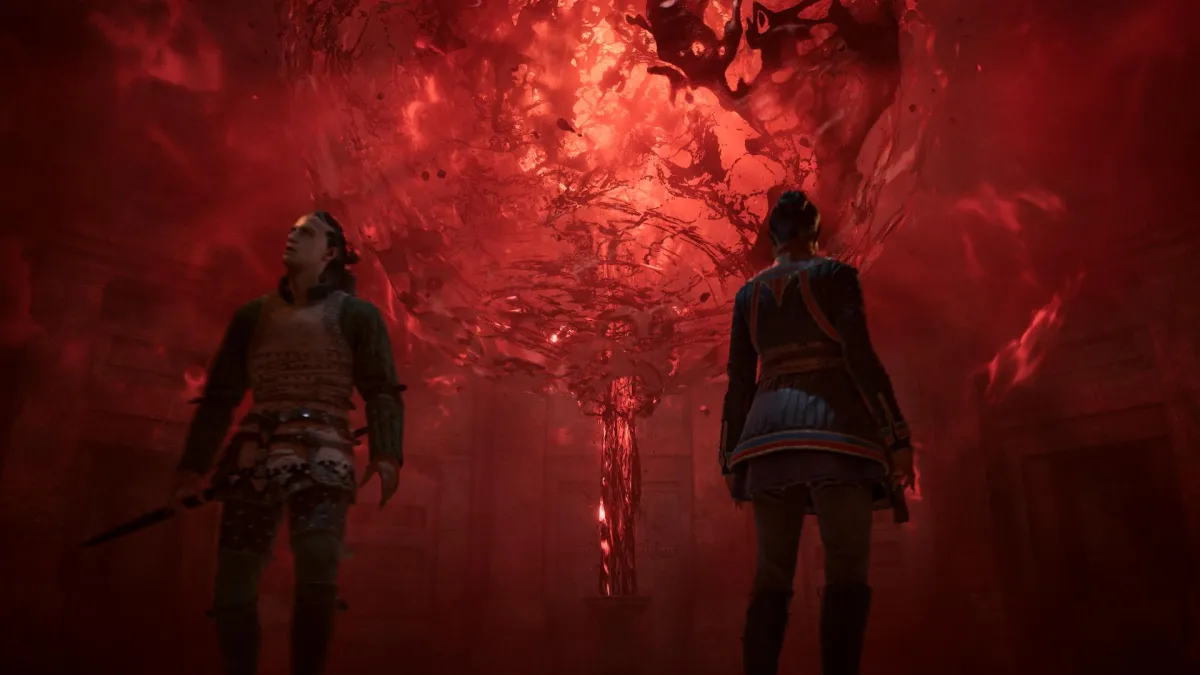
In an era of overconsumption, The Blood of Dawnwalker shows the potential of limitation. You have 30 days to rescue your family from the fangs of a vampire court. Strengthening yourself for the final fight, whether by improving your skills or helping others forge alliances, moves time forward. As uneven as this mechanic (and others) may be, it brings a breath of fresh air to an often excessive genre. After a dazzling prologue, Rebel Wolves’ open-world RPG gives you free rein to tame it as you see fit. The studio was formed by CD Projekt Red veterans, which shows; Almost every element bears the fingerprint of The Witcher 3: Wild Hunt. If you’ve played Geralt of Rivia’s epic, Coen’s adventure of Laslea will feel all too familiar. The dialogue structure, the tone of the missions, the conceptually novel combat that falls short in practice, and the way you immerse yourself in the myriad question mark icons on the map make it impossible to avoid comparisons. Fortunately, as much as the studio relies on the acclaimed formula previously established by its founders, it attempts to subvert it. The mechanics of time is a great example. Instead of having a clock that always ticks, time is dictated by your actions. Since Coen is a Dawnwalker (a human by day and a vampire by night), you have access to day and night spaces. Digging for treasure buried underground can take up space. Playing tag with your siblings or searching for missing explorers can take up three slots. At first, the promise of this mechanic seems limitless, as you must carefully consider how you approach each cycle and decide what is truly worth spending your time on. At first, it is quite effective in conditioning your choices. During one of the first optional quests, I tracked down a grave robber who had desecrated a young man’s grave to steal his silver necklace to craft arrows, an effective weapon against vampires in this world. Unfortunately, I ran out of time before I could return it to the grieving mother. Later, finding out that I still had the necklace in my inventory is surprisingly heartbreaking for what was technically a simple fetch quest. Taking on the titular vampire in The Blood of Dawnwalker is a tempting task, as the quest is available from the jump. You can literally exit the prologue and try to fight him. This would be absurdly difficult, so you have 30 in-game days to grow your character and find people willing to lend a hand in the final showdown. You can also hunt down the other three members of the vampire court to further turn the tide in your favor. However, the time pressure progressively eroded as I approached the end of the 30-day period. For reference, I was warned about the point of no return if I accepted help from a character with 13 days to spare. Until then, I was being overly cautious about how I spent my time. Obtaining skills and their respective upgrades requires points, but the action itself also uses time slots. Doing so made Coen stronger, but it was time he could have spent helping more people. The moment I saw the sign of no return, the pressure completely disappeared. It doesn’t help that I unlocked three additional routes to tackle it shortly after the first, as if the story was urging me to put an end to it. Coen’s own vampirism is equally fluid. His concept has great potential, as magic can only be used during the day, and the entire skill set is replaced by vampire abilities at night. Some activities and quests are specific to each cycle, and you can mix and match two armor builds, as equipment often has bonuses for each Coen character. Of course, once the sun sets, you also need to satisfy your bloodlust by feeding on animals or humans. If you don’t, you risk giving in to hunger during conversations, which could kill important characters. The prospect of killing outside of your control is terrifying, but I’ve never seen it in action, since blood is tied to health. I never ran out of healing items, and while you can feed during combat, there was no shortage of targets to feed from outside either. The most notable features of The Blood of Dawnwalker never come together. The backbone of the combat also falters. It starts with a similar promise: blocking requires you to follow directional cues to effectively respond to attacks. However, enemies tend to repeat move sets. Aside from the main boss fights, the confrontations are repetitive Simon Says sequences. Nonetheless, I was captivated by the gritty world on display, especially as I learned more about the corrosive nature of the vampire court among the townspeople. Not only are they killing hundreds, but they are also corrupting aspects such as faith and becoming religious iconography in churches and organizing baptisms with blood instead of holy water. Despite my mechanical complaints, I remained invested in Coen’s story until the end. The final confrontation summed up the many decisions and paths I took and made me face their ramifications one after another. I may not have been fazed by the pressure of the time mechanic, but the limitation did shape my adventure. The Blood of Dawnwalker shows that creating a massive RPG instead of chasing each and every quest has immense potential. The ending made me realize that having all the time in the world would have prevented the inner ambitions from finally coming to the light of day.