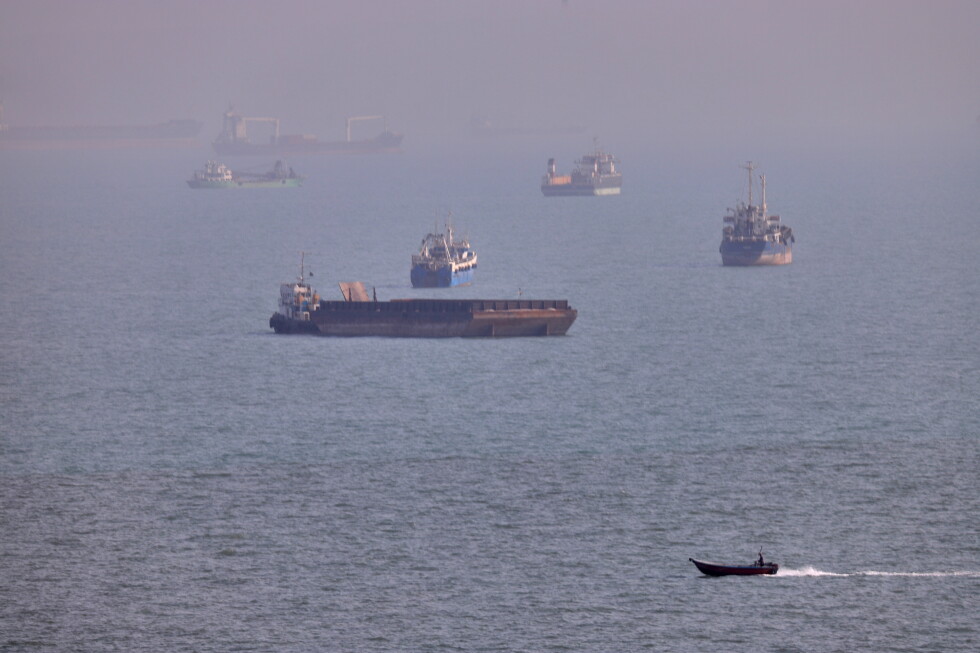
DUBAI, United Arab Emirates (AP) — The United Arab Emirates air force intercepted an Iranian drone over its territorial waters on Monday, the Defense Ministry said, an attack that comes after the United States and Iran exchanged fire over the weekend, the first significant military action in a month. During the lull in fighting, the United States has been increasing economic pressure on Iran in hopes of forcing Tehran to make concessions, including reopening the vital Strait of Hormuz to shipping. After the United States and Israel attacked Iran on February 28, Iran established a chokehold in the strait, through which a fifth of the world’s peacetime traded oil passed, reducing shipping traffic to a minimum. As fighting resumed, the price of Brent crude oil, the international standard, rose above $90, about 25% higher than at the start of the war, presenting a growing problem for US President Donald Trump ahead of the midterm elections. UAE says Iranian attack is ‘dangerous escalation’ In a brief statement, the UAE Ministry of Defense said it has “dealt” with an Iranian drone that was detected over its waters approaching from Iran. There were no reports of damage. “This dangerous escalation constitutes a flagrant violation of the sovereignty, security and stability of the United Arab Emirates, and a direct threat to the security of its citizens and residents,” the Ministry of Foreign Affairs said. The Defense Ministry subsequently issued a second statement denying the Iranian military’s claim that the Al Minhad air base in Dubai had been attacked, saying it was false. The incident came after US forces attacked Iranian rocket launchers on an Iranian island on Sunday, breaking a lull in fighting in the war that has lasted more than six months. Iran responded by launching missiles at US sites in Jordan, which were intercepted. Earlier Monday, Iran’s Foreign Ministry said Iran “would not hesitate to exercise the inherent right of self-defense and will respond decisively to any military aggression.” Iran says it has the right to defend itself and will ‘respond decisively’ Before attending the Shanghai Cooperation Organization summit in Kyrgyzstan with Foreign Minister Abbas Araghchi, Iranian President Masoud Pezeshkian, who has favored a negotiated end to the conflict, stressed that Iran was not seeking war. “But,” he said, “we will respond decisively to the attackers.” The summit brings together a group seen as a counterweight to US global influence, and includes Chinese President Xi Jinping, Russian President Vladimir Putin and Indian Prime Minister Narendra Modi. Pezeshkian was scheduled to meet with Putin on the sidelines on Tuesday. Subscribe to Morning Wire: Our flagship newsletter breaks down the day’s biggest headlines. The weekend attack in the United States comes after weeks of increasing economic pressure. Meanwhile, US Treasury Secretary Scott Bessent hosted meetings of the Group of 20 finance ministers in North Carolina on Monday and Tuesday, which come as Washington pressures other countries to help the US economically isolate Iran. The shifting strategy centers on threats to punish any country or entity that continues to do business with Tehran. Two weeks ago, the United Arab Emirates suspended all trade with Iran after saying it had come under renewed fire from Iran with two missiles fired at shipping traffic landing harmlessly in the Persian Gulf. Iran denied the attack. Bessent later suggested that it was pressure from Washington that led to the UAE’s decision. Trump emphasized last week that he is “in no rush” to get Iran back to the negotiating table, and continues to argue that the Islamic Republic’s leadership is on the ropes. However, appointments to top Iranian security positions in the past month have signaled Tehran’s defiance after enduring decades of sanctions, as well as a lack of tolerance for dissent in the country. The US military says the attack on Iranian rocket launchers is “limited” and “precise.” On Sunday, the US Central Command said it had struck Iranian launchers after observing forces with Iran’s Revolutionary Guard Corps preparing to launch rockets laced with sea mines into the Strait of Hormuz. The US military said last week it had completed clearing sea mines from the waterway’s international shipping lanes. Iran’s semi-official media reported sounds of explosions near the island of Larak in the strait and the Revolutionary Guard said there had been casualties. U.S. military officials disputed Iran’s claim that the latest U.S. strikes were an act of aggression, calling them “limited and precise action” against what they said were undermining forces. Iranian state television later showed what it said were ballistic missiles fired at US bases in Jordan, and the Jordanian military said it intercepted eight that had entered its airspace. The US military last confirmed it had attacked Iran on July 29, when it announced a “strong wave of strikes” against dozens of Revolutionary Guard targets, including coastal defense and surveillance sites. Trump said on August 1 that he would order the military to postpone further attacks at the behest of Gulf allies Qatar, Saudi Arabia and the United Arab Emirates.