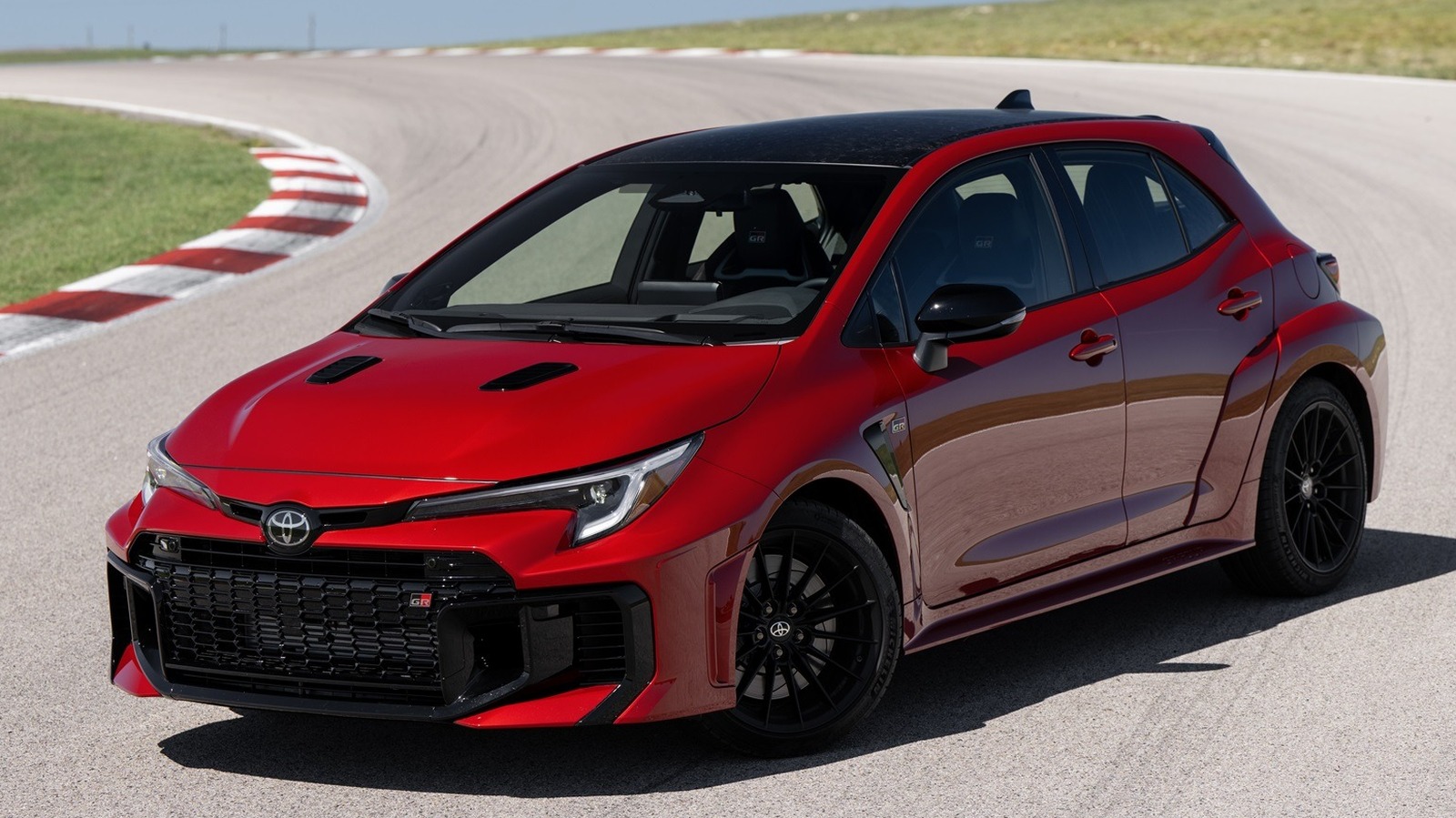
The Toyota GR Corolla is a very hot hatchback with incredible performance stats. It combines a 1.6-liter three-cylinder turbocharged engine that produces 300 horsepower with an all-wheel drive system that can put all of its prodigious power down on the tarmac. It is descended from and remains essentially a street legal rally car. Drivers have a choice of a six-speed manual or an eight-speed automatic transmission with paddle shifters. Our review of the GR Corolla found that the turbo hatchback shines with a stick.
According to testing performed on the six-speed GR Corolla by Car and Driver, it did 0-60 mph in 4.2 seconds and 0-100 mph in 10.7 seconds. The quarter-mile went by in 12.8 seconds at 108 mph, while roadholding on the skidpad was measured at an excellent 0.97g. In the braking test from 70 mph, the GR Corolla took 154 feet to stop.
But as amazing a vehicle that the Toyota GR Corolla is, it is not perfect by any means. Numerous sources have pointed out some common issues that you could experience if you are the owner of one of these amazing cars. While some of these problem areas are a result of driving the car hard either at the track or on the road, other difficulties have been noticed afflicting the infotainment and instrument displays, as well as concerns relating to ride comfort. Owners of these vehicles have discovered solutions to many of these things, also suggesting the observance of maintenance schedules to keep the GR Corolla running at its best.
The Toyota GR Corolla can suffer from clutch wear issues
A major concern that Toyota GR Corolla owners have noticed relates to how much the clutch wears, particularly involving use at the track, or even during normal operation if practices like clutch slipping, frequent hard launches, or abusive shifting are employed. Treating your clutch like this will virtually guarantee that you’ll need a new clutch every 20,000 miles or so — at a replacement cost of around $2,000.
If you are buying a GR Corolla used, this is one of the key issues to look out for. So, if the clutch pedal happens to engage at a high point along its travel, you may be in for that $2,000 bill before long. Of course, choosing the eight-speed automatic transmission option makes this issue moot, and our review of this GR Corolla variant discovered that the new automatic option only makes it better.
There are a number of ways to reduce or eliminate the clutch wear issues that have befallen the Toyota GR Corolla. Primary among them is for the driver to stop abusing the clutch by not slipping it, matching the revs correctly, and generally being smooth with it at all times. If this is not possible, or it does not solve the complete problem, an upgrade to a higher-performance clutch system may reduce the rate of wear that you are imposing on it. There are some reports that Toyota has improved the quality of the clutch system’s parts in the more recent models, so some hope remains that the worst of this issue has passed.
The Toyota GR Corolla can overheat its rear differential/all-wheel drive coupling
Another GR Corolla issue is the tendency of the rear differential/all-wheel drive coupling to overheat. Just as with the clutch wear problem, this overheating issue seems to be directly related to an owner’s likelihood of enjoying a day at the track, or even pushing the car hard during a spirited drive on your favorite local roads.
This problem appears to be congenital, due to the design of the GR Corolla’s clutch pack, which slips to manage and distribute its abundant torque, with the ability to send as much as 70% of it to the rear wheels. This clutch pack generates lots of heat when the car is driven aggressively. The buildup of heat within this component can reach the point where there will be no more torque being sent to the rear axle, giving the driver an ‘AWD Overheated’ warning signal. The system will then switch the car to front-wheel drive limp mode until the system cools down. This directly reduces the level of performance that is available from the GR Corolla and can also lead to increased wear on these key parts of the car’s AWD system.
There is a generally recognized solution to this problem, which involves adding an aftermarket oil cooler to the rear differential/all-wheel drive coupling. This consists of an electric pump that circulates the differential fluid while passing it through a radiator to cool it down. It eliminates much of the excess heat and maintains the car’s high level of performance, even during strenuous track use. The cost is around $1,200.
The Toyota GR Corolla has a driveline vibration problem
While a week with the Toyota GR Corolla could change the way you see daily drivers, there are additional issues to be aware of that could be an obstacle to your total enjoyment. There have been some reports made by GR Corolla owners about a humming sound or even vibrations that manifest themselves when cruising on the highway at speeds of 75 mph or higher. This has also been noticed when the all-wheel drive coupling in the rear is pushed near its limit.
Reasons for these vibrations in the drivetrain components have been traced to several possible causes. These include the rear differential or all-wheel drive coupling experiencing a load, tires that may have worn unevenly or aren’t properly balanced, or minor alignment issues with the various pieces of the GR Corolla’s drivetrain that occurred when the car was originally assembled at the Toyota factory.
There have been a number of solutions proposed for this high-speed vibration or humming problem. One involves checking the driveshaft torque settings and their correct alignment at all manufacturer-recommended service appointments. Another concerns making sure that the hardware connecting the differential to the body is secure, and that the differential fluid and the bearings used are properly maintained and replaced when necessary. One more option is to look carefully for any defective tires or wheels, and if that is not the cause, be sure that the tires have been correctly balanced. Resolving this could lead to your relationship with your Toyota GR Corolla becoming a daily love affair.
The Toyota GR Corolla has issues with its instrument panel, wireless charging, and interior comfort
Another area of concern with the GR Corolla is its electronic readout panels. In fact, in November 2025, Toyota recalled an unspecified number of GR Corollas due to an instrument panel software error that could cause it to, “…fail to display vehicle speed, brake system, and tire pressure warning lights.” If you are the owner of a GR Corolla that is subject to the recall, you have likely received a recall notice, which will entitle you to a full repair of the problem. Other electronic-related issues have to do with the wireless phone charger not doing its job properly.
In addition to definitely having the recall done if you are an affected owner, advice from owners and blog writers strongly suggest that you keep up with all updates for both firmware and software — these can be the best way to fix your display-related bugs. If you have a persistent problem, document it fully and deal with it before the warranty runs out. Wireless charging solutions mostly involve having your phone in the proper position and not using a case that’s too thick for charging.
Even though most GR Corolla owners understand Toyota’s mission statement that this is a rally car for the road, there have been some grumblings about the car’s general comfort level. While owners can soften the suspension or switch to higher-profile tires to improve the car’s ride comfort, these fixes may compromise the inherent hardcore nature of the GR Corolla, which our review of the Circuit version considered the new standard for hot hatches.
The Toyota GR Corolla has problems with its cooling and oiling systems
Let’s face the facts — the Toyota GR Corolla packs a 1.6-liter turbocharged engine that produces 300 horsepower. That comes out to 187.5 horsepower per liter, making this an extremely high-output little engine that has limited ways to manage the huge amount of heat it generates in the course of its operation. Both the cooling system and the oil system bear the brunt of the heat management. Driving the GR Corolla on either the track or a spirited local drive on your preferred winding road can push this unique car to its limits, requiring a meticulous approach to its care and feeding.
This means regular cooling system maintenance, making sure that the level of coolant is correct and nothing is obstructing airflow to the radiator. Upgrading the coolant hoses to silicone is another good idea. For the oil system, heavy track use may necessitate the use of additional oil, transmission, and differential coolers to keep all those temps under control. Use the best possible oil in your GR Corolla, especially if you track it.
The Toyota GR Corolla is a remarkable car, one that had to clear many hurdles before making it from rally car to a production vehicle that must meet all emissions and safety standards, while still meeting its owners’ expectations. Even though the GR Corolla is not without its flaws, there is a growing community of owners finding solutions, as well as shops that are providing support for those owners. As we stated in our original alert about this extremely talented vehicle, you’re right to be excited.