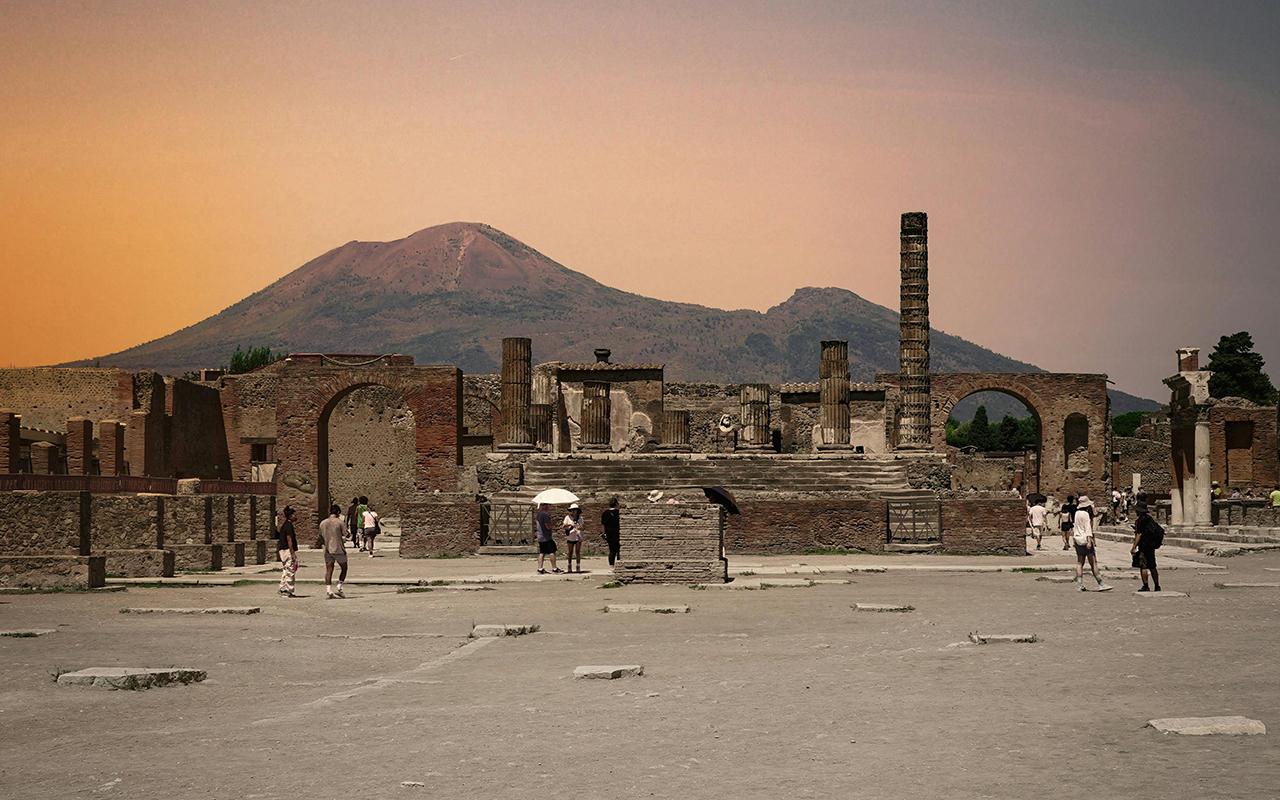
A new study has made argon-argon dating more precise using the well-recorded eruption of Mount Vesuvius in 79 CE. Sunset over the ancient ruins of Pompeii, Italy. Credit: Nirjhar Basak The eruption buried Pompeii and killed Pliny the Elder. His nephew, Pliny the Younger, witnessed the event and recorded a detailed account. The researchers used their record as a fixed date to test and improve an important method for dating volcanic rocks. Scientists from the Berkeley Geochronology Center, UC Berkeley, and the University of Padua tested volcanic minerals from Vesuvius. Their results place the eruption at 1,938 ± 13 years before measurement in 2025. The result gives the argon-argon dating a precision of 0.7% and an accuracy of 0.4%. Such precision is rare for an eruption as young as Vesuvius. The work also establishes a new benchmark for dating recent volcanic events. Argon-argon dating tracks the decay of potassium-40 to argon-40. Volcanic minerals contain little argon before an eruption. Once the magma cools and forms rock, argon from radioactive decay begins to accumulate within the mineral. Researchers measure argon isotopes in a sample to estimate its age. Neutron irradiation also converts potassium-39 to argon-39. Comparison of argon-39 and argon-40 provides the basis for age calculation. Aerial image of Pompeii and Mount Vesuvius. Credit: Carsten Steger, CC BY-SA 4.0 The team analyzed eight samples of sanidine, a volcanic mineral rich in potassium. The samples came from pumice deposits at Oplontis, a Roman settlement buried during the eruption of Vesuvius. The Oplontis samples had one important advantage. They came from the earliest stage of the eruption and contained more potassium than previous samples. Andrea Marzoli of the University of Padua collected the samples in 1998. They then remained unused for decades. The researchers later returned to them as they looked for better results than an earlier study from 1997. Several advances helped the new work. The team used better samples, improved mass spectrometry and a new neutron irradiation strategy. The researchers also improved their treatment of isotopes produced by neutrons. These changes helped the team achieve less than 1% accuracy. The new results also yielded a more precise value for the half-life of potassium-40. The researchers calculated a half-life of 12.044 billion years, with an uncertainty of 0.088 billion years. The figure is twice as precise as the previous value from nuclear physics measurements. The historical date of the eruption also needed careful revision. Pliny’s account supports the date of August 24, 79 AD, but some historians have argued for a later date. Cone of Vesuvius. Credit: The Dronaut, CC BY-SA 4.0 Graduate student Caroline Hasler examined the historical record, including a coin found in Pompeii. Some researchers linked the coin to a date in September. Its comparison with other Roman coins suggested production before September. The team allowed for two months of uncertainty around the historic date. Uncertainty had little effect on the calibration of the dating method. The wider date range helped establish the half-life of potassium-40 with greater confidence. The improved method has uses far beyond Vesuvius. More precise dates help researchers compare volcanic eruptions with other events recorded in geological layers. The method also helps to test other dating systems. These include radiocarbon dating for younger organic material and uranium-lead dating for older rocks. The best dates are also important when studying volcanoes near large cities. Examples include volcanic systems near Mexico City, Naples, and Yogyakarta in Indonesia. Records of past eruptions help researchers study how those systems changed over time. The new results also support efforts to bring different geological dating methods closer together. Researchers have used Bayesian methods to compare argon-argon and uranium-lead dates. The stronger Vesuvius result now provides a more precise historical reference for such work. The study also gives argon-argon dating a stronger basis for measuring recent eruptions. Therefore, a Roman disaster from 2,000 years ago has become a useful test for one of geology’s key dating tools. The eruption of Vesuvius now provides a precise reference point for measuring volcanic events over geological time. Publication: Renne, PR, Cassata, WS, Hasler, CEJ, Carter, JN, Fuentes, AJ, Tholt, AJ and Marzoli, A. (2026). Pliny the Younger advances geochronology. Scientific Advances, 12 (39). doi:10.1126/sciadv.aeg262