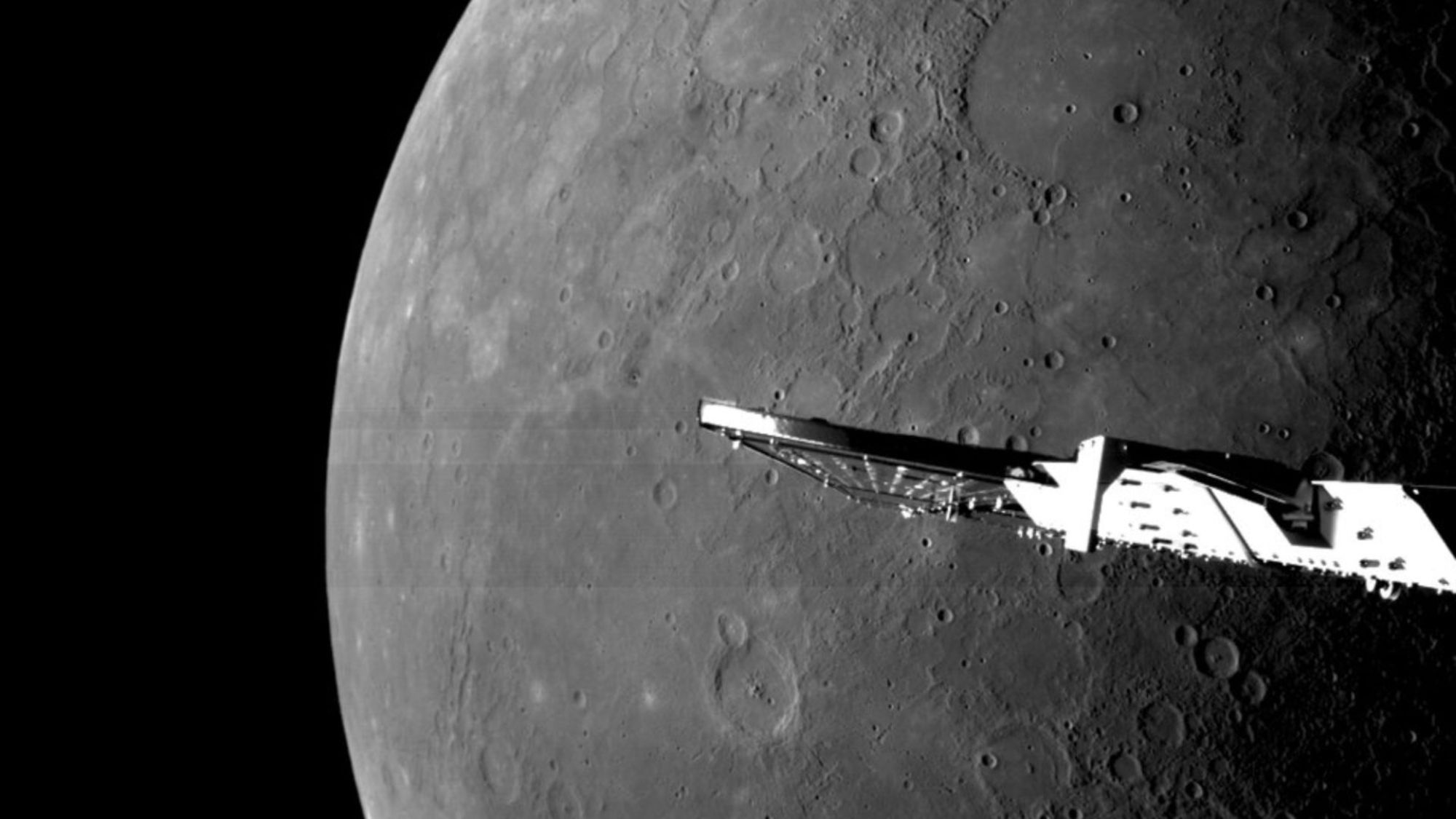
Mercury, the smallest and least explored planet in the inner solar system, hides mysteries far greater than itself, and finally, scientists will soon get not one, but two spacecraft designed to decode this strange world. This is thanks to the BepiColombo mission, a joint project of the European Space Agency (ESA) and the Japan Aerospace Exploration Agency (JAXA) that launched in October 2018. After a harrowing journey through the inner solar system, the mission is tackling a crucial maneuver on Thursday (September 3): separating its scientific equipment from the transport that took it there. By April 2027, scientists hope the mission’s two instrument-packed probes will collect a series of observations that could help solve puzzles about Mercury, and perhaps even the solar system we call home. “I think being able to see new data about Mercury will be fantastic,” Rachel Klima, a planetary geologist at the Johns Hopkins University Applied Physics Laboratory, told Space.com. The planet, he says, is “so strange and beautiful and interesting.” An enigmatic planet For now, Mercury has the dubious honor of being the least explored planet in the inner solar system, visited by only two missions to date. NASA’s Mariner 10 spacecraft made a trio of rapid flybys in 1974 and 1975, giving scientists their first glimpses of the planet’s cracked, cratered surface and confirming that the world has a very tenuous atmosphere and magnetic field. “It really gave us our first close-up view of Mercury,” Sean Solomon, a planetary scientist at Columbia University, told Space.com. “But it left a lot of blank pages.” You might like And for decades, that was it. Scientists didn’t return to Mercury until 2011, when NASA’s MESSENGER spacecraft, with Solomon as its principal investigator, arrived at the small world. (Mercury has a radius of 1,516 miles, or 2,440 kilometers, meaning its width is just over one-third that of Earth.) The spacecraft was packed with tools tailored to the job, such as spectrometers tuned to gamma rays, X-rays and neutrons, and instruments to sniff the atmosphere and measure the magnetic field, and it was there to stay. Four years of observations with MESSENGER showed scientists the entire surface of Mercury for the first time, and at the end of its mission, the spacecraft passed just 15.5 miles (24.9 km) above the planet’s surface. But not even MESSENGER was sophisticated enough to solve the riddles of Mercury or reveal the beginnings of the strange planet. “I think it’s still not known exactly how Mercury was assembled,” Solomon said. Flying over Mercury’s north pole gave BepiColombo’s Monitoring Camera 1 (M-CAM 1) a unique opportunity to observe the shadowy polar craters on January 8, 2025. (Image credit: ESA/BepiColombo/MTM) MESSENGER also opened up some smaller mysteries. He discovered bright, steep pits that scientists called “holes.” He found a set of elements, which planetary scientists call “volatile” because of their tendency to break free from rock, somewhat more prevalent on Mercury’s surface than on Earth’s. He calculated that the center of the planet’s magnetic field is greatly displaced from the planet’s core. Additionally, MESSENGER’s complicated orbit also meant that the spacecraft never saw the southern half of the planet as clearly as the northern half, leaving one side shadowed in doubt. The arrival of BepiColombo It is these mysteries that the ambitious BepiColombo mission hopes to address. In April, if all goes well, the mission will consist of two independent spacecraft collecting independent but coordinated data about Mercury. Europe’s Mercury Planetary Orbiter, or MPO, will focus on the planet itself. It is packed with 11 scientific instruments that will map the terrain, the minerals in the crust and the gravity field, investigate the cavities and volcanic deposits and observe how the barrage of charged particles from the sun affects this innermost planet. Meanwhile, Japan’s Mercury Magnetospheric Orbiter, or Mio, will focus on the planet’s surroundings: its magnetosphere and tenuous atmosphere, as well as the dust that clutters its surroundings. Both spacecraft also carry instruments to measure the planet’s magnetic field, offering simultaneous observations of different parts of the field to scientists who normally settle for data collected from a single location at a time. In fact, some of these instruments have been able to collect observations during BepiColombo’s long journey to Mercury and its six rapid flybys of the planet so far. But because of how the spacecraft was configured for the trip, most of the instruments didn’t (and won’t) come to work until after MPO and Mio have separated. That is expected to happen in December. Mission science, then, has begun only in dribs and drabs, while most of its promise is still ahead. “There is a growing literature on new results coming from the BepiColombo flybys, but I expect them to explode once they enter orbit,” Solomon said. A diagram showing BepiColombo’s path to approach Mercury. (Image credit: ESA) He’s especially excited to see the spacecraft’s sharp views of the southern hemisphere and, in particular, to find hidden deposits of water ice throughout the area. These deposits would exist in deep craters that never feel the heat of the sun. By examining this region of the planet, scientists will be able to reduce the northerly bias of MESSENGER’s data and better see the full picture of Mercury. Meanwhile, Klima is looking forward to MPO’s work to map elements and minerals on the planet’s surface. This work eluded MESSENGER, who used a technique that relied on these rocks being rich in iron and similar materials, but it turned out that those elements were absent, leaving scientists stymied. MPO carries different technology that will be able to read rocks in the world even without iron, which Klima says could help reveal how Mercury (and indeed our entire solar system) formed. Klima says he hopes BepiColombo can get people excited about Mercury, the solar system’s overlooked terrestrial planet: “It certainly doesn’t get the love and attention that Mars and Venus and all the others get.”